I have opened cars with 80,000 miles on the odometer and found the original filter still wearing its factory sticker. Those owners were not careless. Nobody had ever told them the part existed.
While the mechanical side of this job is easy, what trips up first-timers learning how to change cabin air filter is knowing where the filter hides, which direction it faces, and how to read one once it is out. The whole thing runs about fifteen minutes and usually needs no tools. Most shops charge forty to eighty dollars in labor for it.
TL;DR Quick Answers
How to Change a Cabin Air Filter
Your cabin air filter sits behind the glove compartment on most cars. Swapping it takes about fifteen minutes and usually no tools at all.
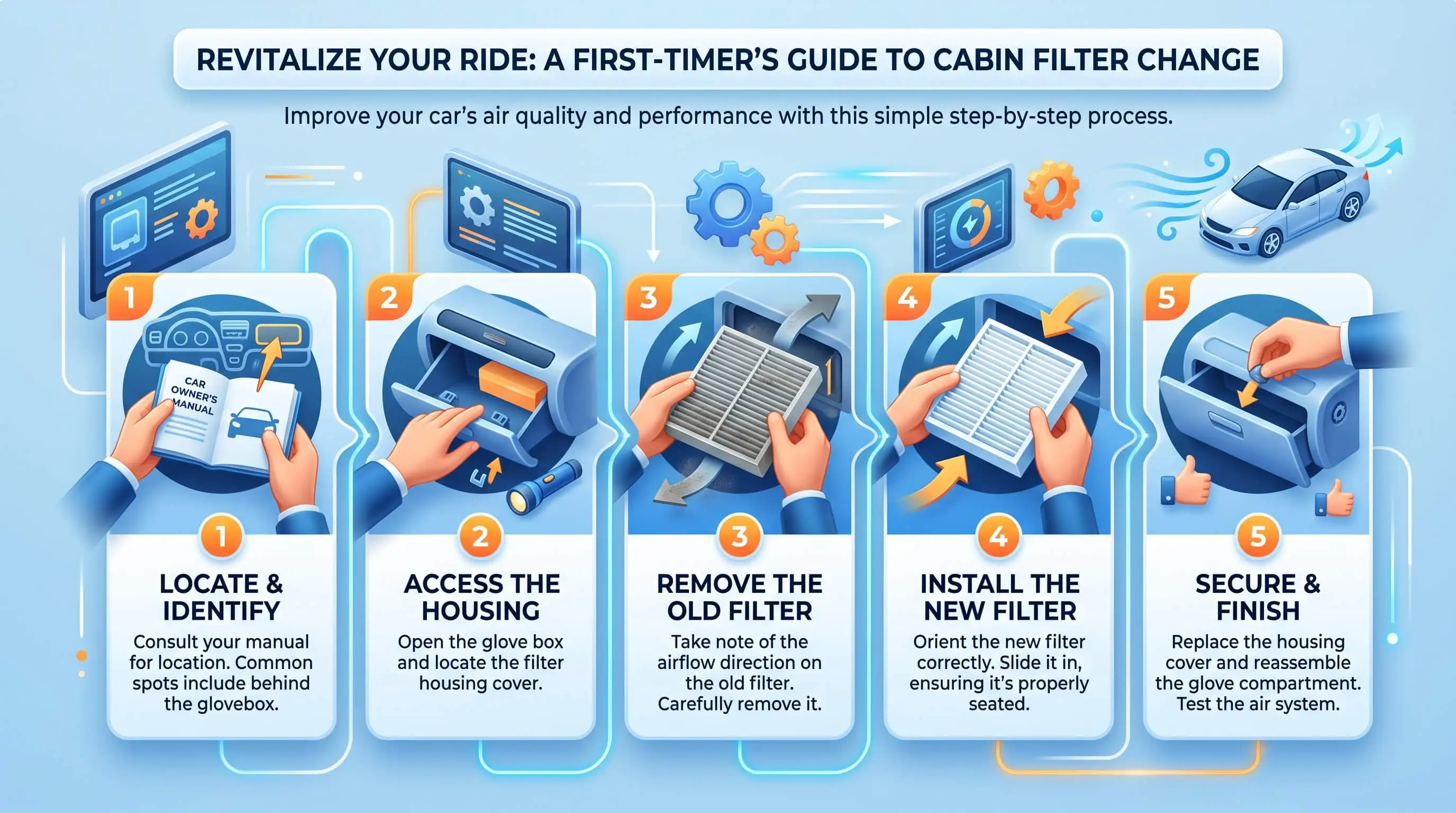
Park on level ground and shut the engine off.
Empty the glove box, then squeeze the tabs on both sides inward so the compartment swings down toward the floor.
Unclip the flat rectangular cover behind it. That is the filter housing.
Slide the old filter straight out and keep it level, so trapped debris does not drop into the blower.
Check the airflow arrow printed on its edge. On most cars it points down.
Vacuum the empty housing, then seat the new filter with its arrow facing the same way.
Clip the cover back on, click the glove box into its tracks, and run the fan on high.
Before you throw the old one away, hold it flat and read how it is loaded. Even darkening across the whole surface means your housing is sealing correctly. Darkening in one section only means air is slipping past the filter instead of through it, and a fresh filter will not fix that by itself.
Replace it once a year, or every 12,000 to 30,000 miles. Go sooner for heavy traffic, dirt roads, pollen season, or wildfire smoke. Paper filters get replaced, never washed. Buy by year, make, and model so nothing sneaks around the edges.
Top Takeaways
The job takes about fifteen minutes on most vehicles and usually needs no tools at all.
Look behind the glove compartment first. That covers the large majority of modern cars.
Match the airflow arrow on the new filter to the old one before it goes in.
Buy by year, make, and model rather than by approximate dimensions, because gaps at the edges let air bypass the filter entirely.
Hold the old filter toward daylight. No light through the pleats means replace it, whatever the odometer says.
Uneven loading across the filter surface points to a housing seal problem, not just a dirty filter.
What Your Cabin Filter Is Actually Catching
Every bit of air your climate system draws in passes through this filter before it reaches your vents. It traps pollen, road dust, brake particulate, diesel soot, mold spores, and the occasional leaf that worked its way down the cowl. You cannot see what floats through the air on your commute. You can see all of it on a used filter, which is why I tell people to look at the old one before they throw it away.
This is a different part from the engine air filter, which protects your motor and lives under the hood. People mix the two up constantly. Buying the wrong one is the single most common first-timer mistake I run into.
When the filter loads up, two things happen at once. Airflow drops, so your fan gets louder while less air actually reaches you. Your blower motor also works harder pushing against that restriction, which is a quiet way to shorten the life of a part that costs real money to replace.
Where It Hides
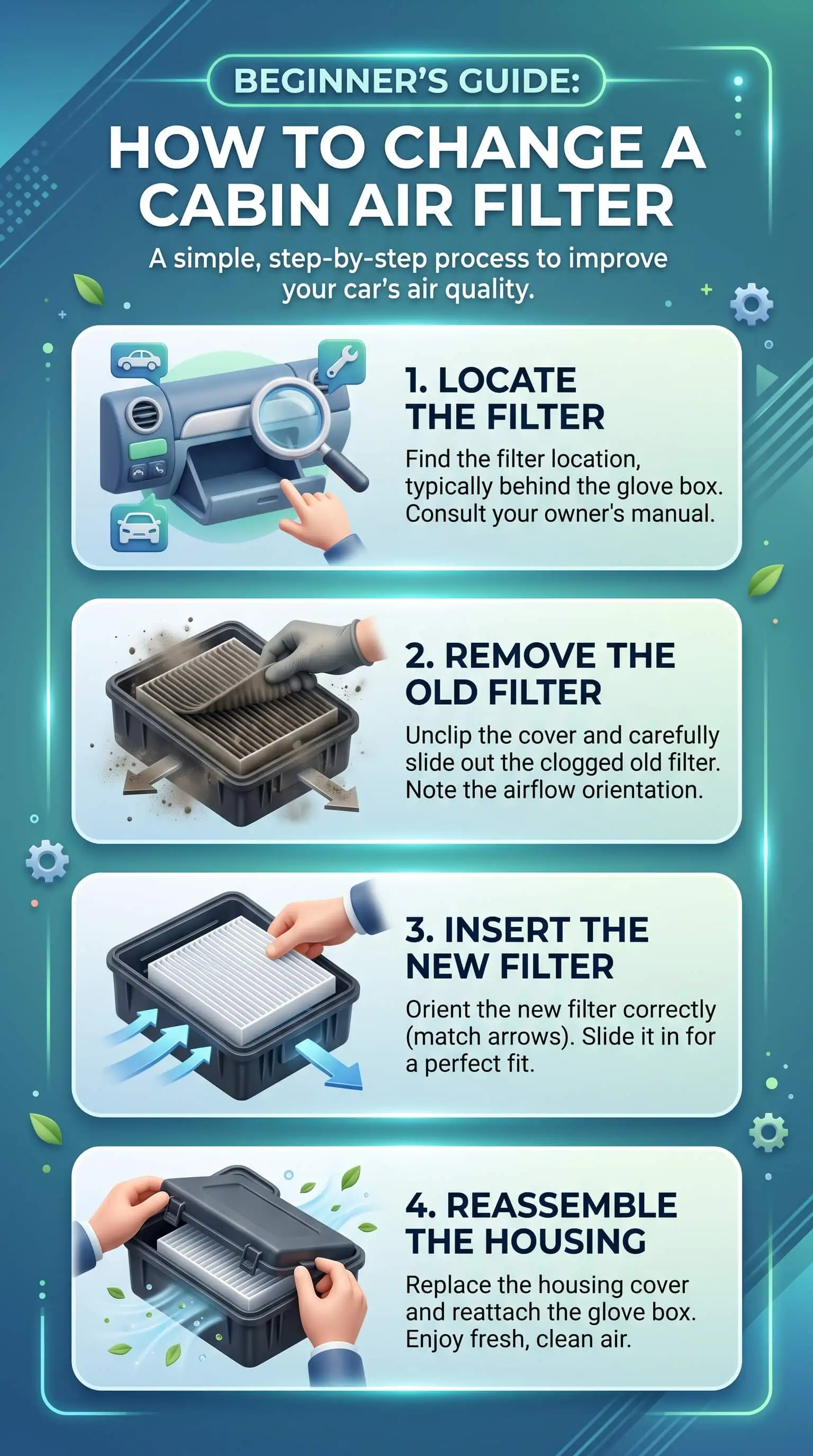
On the large majority of modern vehicles, it sits directly behind the glove compartment. Empty the glove box, squeeze the plastic tabs on either side inward, and the whole compartment swings down toward the floor. Behind it you will find a flat rectangular plastic cover with clips along the sides. That is the housing.
A smaller number of cars put the filter under the hood at the base of the windshield, tucked beneath the plastic cowl panel. A few hide it under the dash on the passenger footwell side. Your owner manual settles the question in one line under the maintenance section.
The Fifteen-Minute Job
Park on level ground and shut the engine off. Empty the glove box completely, because everything in it is otherwise headed straight for your floor mat. Release the side tabs, lower the compartment, unclip the housing cover, and set it somewhere you will not step on it.
Slide the old filter out slowly and keep it level. Loose debris sits on top of it, and tilting it drops all of that down into the blower housing. Before you toss it, check the edge for a small printed arrow. That arrow marks airflow direction, and your new filter has to point the same way. On most glove box installations, it points down.
Spend thirty seconds vacuuming anything loose out of the empty housing. Slide the new filter in until its seats flush, clip the cover back on, and lift the glove box until the tabs click into their tracks. Run the fan on high and listen to the difference. For a photographed walkthrough of each stage before you start, this step-by-step cabin air filter replacement guide covers the same process with the housing fully exposed.
Four Mistakes I See Most
Installing it backward. That airflow arrow exists for a reason. Reversed, the pleats load unevenly and your fan fights the filter instead of pulling through it.
Buying by rough dimension instead of by vehicle. A filter that measures close but not exact leaves gaps at the edges, and unfiltered air takes the easy route straight around your brand new filter.
Washing a paper filter and putting it back in. Paper media does not survive water. Once it is loaded, it is finished, and rinsing it only softens the media while the trapped particulate stays put.
Leaving the housing cover half-clipped. If that cover does not seat, you have built a bypass around the filter you just paid for, and you will never see it because the glove box hides the whole thing.
How Often to Change It
Once a year works for most home air filters, though the right interval depends on how much dust, pollen, and other debris your home collects. Shorten that interval if you live near heavy traffic, have construction nearby, keep windows open often, or deal with wildfire smoke. If you deal with seasonal allergies, put a fresh filter in ahead of spring rather than waiting on a set replacement date.
The honest test takes five seconds. Pull it, hold it toward daylight, and look. No light through the pleats means it is done, and no mileage chart outranks what you can see with your own eyes.
"The thing I wish somebody had told me my first time is that a used filter tells you a story if you actually read it. I pulled one out of a commuter car a few winters back where the top third was black and the bottom two thirds were nearly clean. That is not normal loading. That is a housing seal that had failed, letting air bypass the media entirely, and the owner had been buying filters that never got the chance to do their job. I would have missed it completely if I had dropped the old one straight in the trash. So hold it flat and read the loading pattern across the whole surface before you throw it out. Even loading means your system is sealing correctly. Uneven loading means you have a second problem sitting behind the dash, and a fresh filter alone will not touch it."
7 Essential Resources
Air Filter (Wikipedia) covers filter media types and how automotive cabin filters differ from other filtration applications.
Car Care Guide (Car Care Council) is a nonprofit maintenance reference with service intervals for cabin and engine filters alongside the rest of a vehicle checklist.
Cabin Air Filter Replacement (AAA) walks through replacement intervals, typical cost ranges, and what these filters are built to capture.
Clean It or Replace It (NAPA Know How) sorts out which filter media can be washed and reused and which has to be discarded.
Using the Air Quality Index (AirNow) is the federal tool for checking daily particulate levels, which helps you decide when to run recirculation on your drive.
Air Quality Index (American Lung Association) turns air quality readings into practical guidance for people managing asthma and other respiratory conditions.
Asthma and Allergy Forecast (Allergy & Asthma Network) tracks pollen and mold conditions, which is the clearest signal for timing a seasonal filter change.
These resources explain cabin air filter types, replacement timing, air-quality conditions, and maintenance practices, while an HVAC tune up can also help ensure filtration and airflow systems are working efficiently.
3 Statistics
A randomized cross-over study of 48 commuters published in Environmental Science and Technology found that cabin air filtration cut in-vehicle particulate concentrations by roughly a third: PM2.5 dropped 30 percent, ultrafine particles 28 percent, and black carbon 32 percent against an unfiltered control. National Library of Medicine
Researchers measuring six commuting modes along one urban route recorded mean PM2.5 exposure of 5.20 micrograms per cubic meter while driving with windows closed, against 15.21 micrograms per cubic meter with windows open. The sealed, filtered cabin came in lowest of all six modes tested. PLOS One
More than 45 million people in the United States live within 300 feet of a major road, rail line, or airport, which puts a large share of the driving population in steady contact with traffic-related pollution. U.S. Environmental Protection Agency
Research shows that effective cabin filtration can significantly reduce exposure to PM2.5, ultrafine particles, and black carbon, especially for drivers near heavy traffic, making top air filters an important part of improving in-cabin air quality.
Final Thoughts and Opinion
Here is my position after doing this more times than I can count. The cabin air filter is at once the most oversold line on a shop invoice and the most neglected item in the average driveway, and both of those are true at the same time. Shops bill forty to eighty dollars in labor for fifteen minutes and no tools. Drivers hear that number, assume the job must be complicated, and then ignore it for four years.
I will push back on one piece of standard advice. The mileage interval printed in your manual was written for a generic driver in generic conditions, and almost nobody is that driver. Someone putting 8,000 dry highway miles on a car every year can stretch it well past the recommendation. Someone crawling through construction traffic or living downwind of an agricultural field cannot come close to it. Look at the filter, not the odometer.
The counterargument is worth hearing. A fair number of mechanics will tell you how quality filters are a comfort item rather than a safety or reliability item, and that a clogged filter has never left anyone stranded on a shoulder. That is true on its own terms. I still treat it as maintenance rather than luxury, and the reason is the blower motor, which is a genuine repair bill, plus the in-cabin exposure research that has gotten considerably more serious over the last decade.
Frequently Asked Questions
How long does it take the first time?
Give yourself twenty to thirty minutes on your first attempt, mostly spent locating the housing and working out how the glove box tabs release. Every time after that lands closer to ten.
Do I need any tools?
Usually none. A flashlight helps you see under the dash, and a small flat screwdriver comes in handy for popping a trim panel on certain models. Neither one is required on most cars.
What happens if I install it backward?
The filter still catches particles, but the pleats load unevenly and airflow drops sooner than it should. Nothing dangerous happens. You just get less filter life and weaker vents, so pull it out and flip it.
Can I clean my old filter instead of replacing it?
Not if it is paper media, which most factory filters are. Water wrecks the media, and vacuuming pulls surface debris while leaving the loaded pleats exactly as they were, much like dryer vent cleaning removes buildup rather than restoring worn filter media. Some cloth and carbon filters are built to be washed, and those say so right on the frame.
Will a new filter fix a musty smell?
Often yes, because that smell usually comes from organic material trapped in the old media. If the odor sticks around after a fresh filter goes in, you probably have moisture or mold in the evaporator housing, and that one needs a shop.
Is a cabin filter the same as an engine air filter?
No. The cabin filter cleans the air you breathe and sits near the dashboard. The engine air filter protects your motor and sits under the hood. Different parts, different sizes, and the two most commonly confused items in this whole job.
Does a clogged filter affect my air conditioning?
It changes how much cooled air reaches you and how hard your blower has to work, which drivers experience as weak AC. MERV 8 pleated HVAC furnace air filters can similarly affect airflow when they become loaded with dust. The refrigerant system itself stays unaffected, so a new filter will not rescue an AC system that is actually low on charge.
CTA
Go check your furnace filter right now. Two minutes tells you whether it is still clean enough to do its job or already needs replacing. Pull the furnace filter, hold it toward the light, and you will know before you finish your coffee whether this weekend needs fifteen minutes of your time.
If your housing does not match anything described here, drop a comment with your year, make, and model. I answer every one, and the odd layouts are exactly the ones worth documenting for whoever reads this next.