So what's the best hypoallergenic hand soap for nurses? The one with the fewest irritants. Look for a formula without SLS, synthetic fragrance, or dyes, and if you can find one, a formula that skips the soak-and-dry routine your hands repeat all day.
We're Dr. Ruslan Maidans, a dentist, and Dr. Yalda Shahriari, a biomedical engineer. We started NOWATA after watching "gentle" products irritate skin over and over, first on our own kids and then on Ruslan's dental patients, some of whom developed chronic hand eczema from their jobs.
Before we formulated anything, we knew four things:
Hand dermatitis ranks among the most common work-related skin problems in nursing
Wet work does more damage than any single ingredient
"Hypoallergenic" has no federal definition, so the word on a bottle proves nothing
On the floor, your facility's hand hygiene protocol comes first
We mean that last one. We're not asking anyone to skip the sink or the sanitizer dispenser. We want to help your skin through the hours your protocol doesn't cover.
When our own family needed something gentler, we made a gentle, non-irritating hypoallergenic hand soap made for sensitive skin. We kept it plant-based and rinse-free, so it leaves nothing behind on skin that's already had enough.
On this page, you'll find why nurses' hands break down so fast, which ingredients to skip, where your own soap fits alongside facility protocol, and a shift-day routine that gives your skin time to recover.
TL;DR Quick Answers
Hypoallergenic Hand Soap
Definition: Hand soap made to lower the chance of allergic reactions and skin irritation.
The catch: The FDA has no federal standard for "hypoallergenic," so any brand can print it without testing.
What to look for instead:
SLS-free
Fragrance-free, not just "unscented"
Dye-free and paraben-free
A short, plant-based ingredient list
Independent lab testing behind any cleaning claim
For nurses: Follow your facility's protocol on shift. The CDC says alcohol-based hand rub is gentler than frequent soap and water. Off the clock, a rinse-free formula gives skin a break from the wet-dry cycle behind most hand dermatitis.
Our experience as doctors: We trusted "hypoallergenic" labels for years, and our kids' hands still turned red. The ingredient list told us what the label wouldn't.
Bottom line: Skip the label and read the ingredients.
Top Takeaways
Hand dermatitis is an occupational hazard for nurses.
The CDC says some healthcare workers clean their hands up to 100 times a shift
Wet work and sweaty gloves do most of the damage
"Hypoallergenic" is unregulated.
The FDA says the term has no federal standard
Action: read the ingredient list, never the front label
Some ingredients are worth skipping every time.
SLS, synthetic fragrance, dyes, and harsh preservatives top the list
Fragrance-free and "unscented" aren't the same thing
Short, readable ingredient lists are a good sign
Independent lab testing should back any cleaning claim
Your facility's protocol comes first on the floor.
The CDC prefers alcohol-based hand rub in most clinical situations and says it's gentler than frequent soap and water
Facility-approved lotions won't interfere with sanitizer
Your skin needs recovery time off the clock.
Rinse-free, plant-based cleansing skips the wet-dry cycle
We built NOWATA for the hours outside the protocol
Persistent cracks or blisters call for occupational health or a dermatologist
Why Nurses' Hands Break Down Faster Than Almost Anyone Else's
Your hands almost never get a full day off. Each shift adds the same stressors to the same skin:
Dozens of washes or hand rubs
Hours inside gloves that trap sweat
Paper towels, cold air, and dry hospital ventilation
Cleaning agents on surfaces and equipment
Dermatologists call this wet work. Water swells the outer layer of skin. Then it dries, swells again, and each round strips a bit more of the oil that keeps your skin barrier intact.
The damage usually shows up one of two ways. With irritant contact dermatitis, the most common type, the barrier wears down until you see redness, stinging, and cracks across the knuckles. Allergic contact dermatitis works differently, because your immune system reacts to one specific ingredient, often a fragrance or preservative, and the itching and swelling keep coming back. Similar irritation can occur during household tasks like dryer vent cleaning, especially when dust and cleaning products come into contact with sensitive skin.
Ruslan saw this in his own dental patients. They developed chronic hand eczema from the work they did every day.
What "Hypoallergenic" Actually Means on a Hand Soap Label
Whatever the manufacturer wants it to mean. The FDA says there's no federal standard for hypoallergenic claims, and companies don't have to submit any proof before they print the word.
We learned this the frustrating way. We bought the bottles marked "gentle" and "sensitive," and our kids' hands still turned red.
Our advice to any nurse is the same advice we gave ourselves. Ignore the front of the bottle, flip it over, and judge the soap by what's missing from the ingredient list.
Ingredients to Avoid When You Wash Dozens of Times a Shift
You might never notice an irritant you use once a day. Use it every hour of a twelve-hour shift, and you will.
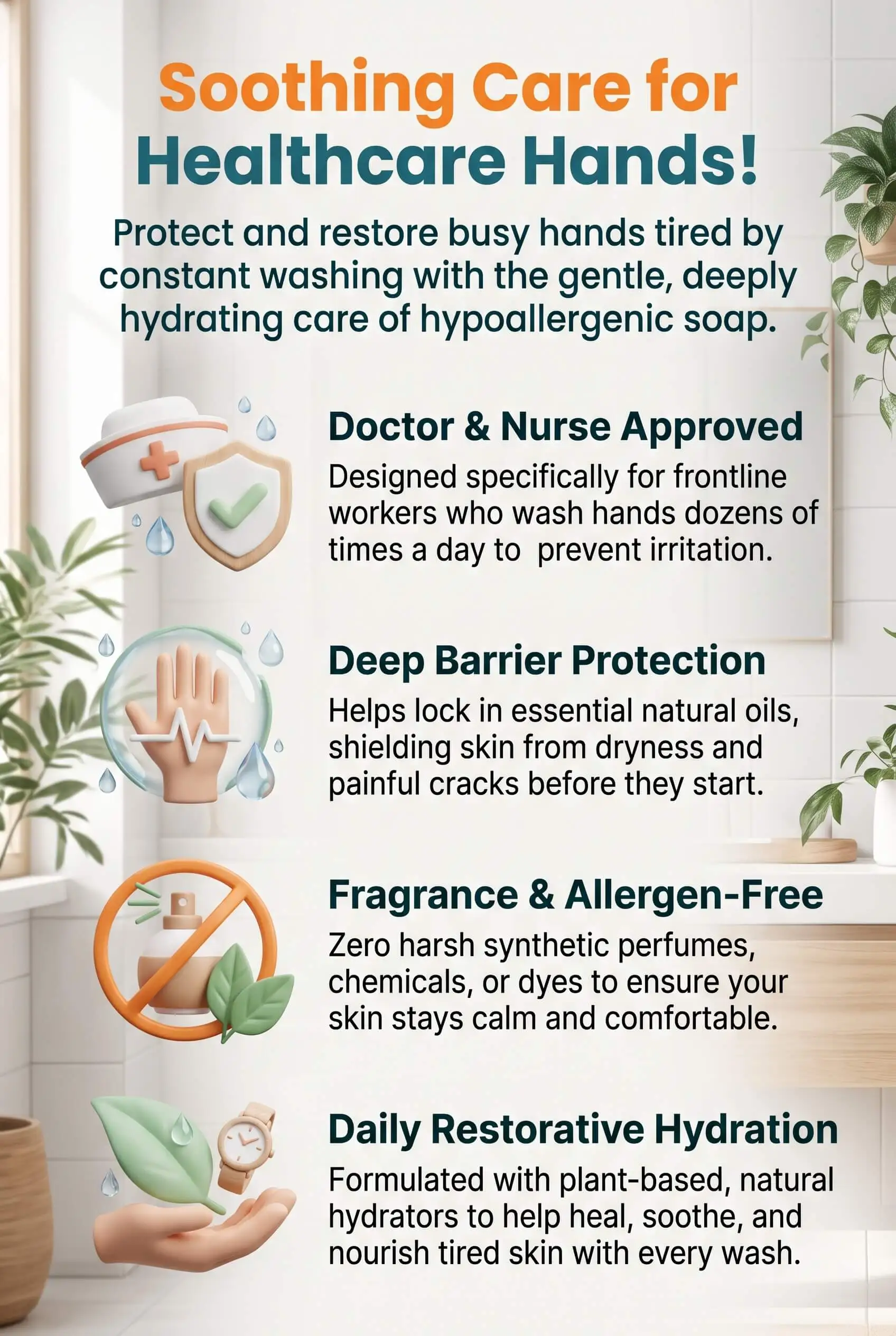
Sodium lauryl sulfate (SLS) breaks down the skin barrier and speeds up water loss. Choose SLS-free, plant-based cleansers instead.
Synthetic fragrance, often listed as "parfum," is a leading cause of allergic contact dermatitis and can hide undisclosed chemicals. Pick truly fragrance-free, which isn't the same as "unscented."
Artificial dyes don't clean anything, so all they bring is irritation risk.
Parabens and harsh preservatives can set off reactive skin. Favor short ingredient lists you can actually read.
High-pH bar soaps tend to leave hands tight and dry after repeated use.
What to Look For in a Hypoallergenic Hand Soap for Nurses
You want a short ingredient list, none of the common sensitizers, and testing you can check for yourself. Here's the checklist we use:
Fragrance-free, not "unscented"
No SLS and no dyes
An ingredient list you can read in one breath
Independent lab testing behind any cleaning claim
Nothing that clashes with your facility's approved moisturizers and gloves
Where Your Facility's Protocol Fits
On the floor, your facility's protocol wins every time.
The CDC's guidance for healthcare workers leaves no doubt about this. In most clinical situations, the CDC prefers alcohol-based hand sanitizer and says it causes less irritation and dryness than frequent soap and water. You still need soap and water when your hands are visibly soiled, before you eat, after you use the restroom, and during outbreaks of C. difficile and norovirus. And gloves never replace hand hygiene.
A lot of nurses don't expect that. Sanitizer usually isn't the main culprit, since repeated washing and sweaty gloves tend to do more harm.
Nobody has to choose between their patients and their hands. The fix lives in the hours around the protocol.
Giving Your Skin Recovery Time Off the Clock
Your skin does its healing while you're off duty. That makes the time before your shift, your breaks away from patient care, the drive home, and your evenings the best places for a gentler routine.
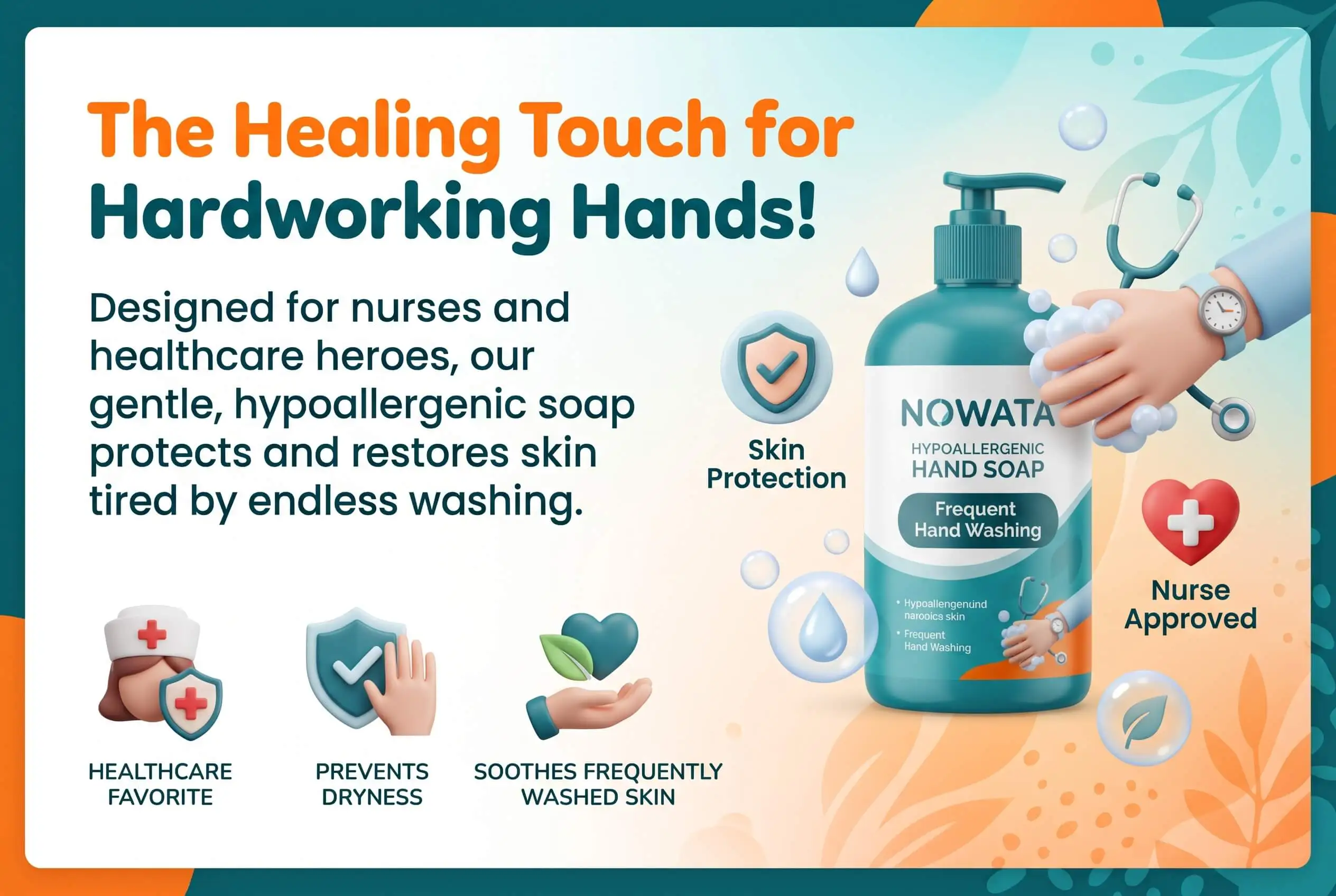
We built NOWATA for exactly that gap. We made it 100% plant-based, left out SLS, alcohol, synthetic fragrance, and parabens, and designed it to work without water. If you're curious about the difference, here's how waterless soap differs from a traditional cleanser.
Using it takes about as long as a hand rub:
Squeeze a small drop onto dry hands
Rub for 15 to 20 seconds until small clumps form
Brush or wipe the clumps away
As the clumps fall away, they take dirt and germs with them. We prefer removing germs rather than killing them because it leaves nothing behind and spares your hands the wet-dry cycle.
A Swiss laboratory tested NOWATA with a modified ASTM E1174 protocol and found it physically removed over 99.9%* of bacteria (E. coli) and virus particles (Murine Norovirus, a human norovirus surrogate) from skin.
We want to be clear on one point. NOWATA is for your own hands off the floor, and it doesn't replace your facility's clinical hand hygiene.
A Simple Shift-Day Hand Care Routine
None of these habits change your protocol, and each one helps protect your skin barrier.
Use lukewarm water at the sink. Hot water dries skin faster.
Pat your hands dry, especially between the fingers.
Moisturize on breaks and after every shift with a lotion your facility approves, so it won't interfere with sanitizer.
Off the clock, reach for a gentle rinse-free cleanser instead of making extra trips to the sink.
Before bed, apply a thick fragrance-free moisturizer, and ask occupational health about cotton glove liners if your skin is already irritated.
If cracks, blisters, or itching hang on, see occupational health or a dermatologist.
"In Ruslan's dental practice, we watched patients develop chronic hand eczema from the work they did every day. That stayed with us. Comfort drives compliance more than most people like to admit. A clinician whose hands burn at the sink still washes, but each wash takes a little more of the skin barrier with it. When we started formulating NOWATA, we weren't trying to replace anyone's hospital protocol. We were thinking about the other sixteen hours of the day, from the commute to the break room to home, because that's when skin either recovers or doesn't. We still test every batch on our own family first, and we won't hand anyone a product we wouldn't use ourselves. If you remember one thing from us, remember to read the ingredient list and ignore the label. Your hands do important work, and your soap shouldn't make that work harder."
7 Essential Resources
These are the sources we turn to as doctors, parents, and founders. If your hands take a beating at work, start with these.
1. See exactly what the CDC asks of your hands on shift
The "100 times a shift" figure comes from this page. The CDC also spells out when it prefers sanitizer, when it requires soap and water, and how to keep hand skin healthy while you follow both.
Source: Centers for Disease Control and Prevention
URL: https://www.cdc.gov/clean-hands/hcp/clinical-safety/index.html
2. Get straight answers to the questions nurses actually ask
Sanitizer or soap? Fifteen seconds or twenty? The CDC's Division of Healthcare Quality Promotion answers the questions it hears most often from providers, and it keeps the answers short.
Source: Centers for Disease Control and Prevention
URL: https://www.cdc.gov/patient-safety/stories/what-you-should-know-about-hand-hygiene.html
3. Find out why nurses top the list for hand eczema
The American Academy of Dermatology names nurses, hair stylists, and plumbers as people who often get hand eczema, simply because their hands stay wet so much of the day. It also explains why tracking down the cause matters more than buying another moisturizer.
Source: American Academy of Dermatology
URL: https://www.aad.org/public/diseases/eczema/types/hand-eczema
4. Learn the routine dermatologists recommend for overwashed hands
Wash in lukewarm water, leave your hands slightly damp, and moisturize right away. The AAD also explains why a thick cream from a tube usually feels better on cracked skin than lotion from a pump bottle. We wish we'd read it years earlier.
Source: American Academy of Dermatology
URL: https://www.aad.org/public/everyday-care/skin-care-basics/dry/coronavirus-handwashing
5. Understand the different types of hand eczema and what sets each one off
The National Eczema Association covers irritant, allergic, atopic, and dyshidrotic hand eczema, along with the triggers behind each. It calls hand eczema the most common occupational skin condition, which matches what we saw in Ruslan's patients.
Source: National Eczema Association
URL: https://nationaleczema.org/body/hand-eczema/
6. Read the FDA's own words on "hypoallergenic"
The FDA says plainly that no federal standards govern the term and that it means whatever a particular company wants it to mean. Once you've read that, front labels lose most of their pull.
Source: U.S. Food and Drug Administration
URL: https://www.fda.gov/cosmetics/cosmetics-labeling-claims/hypoallergenic-cosmetics
7. Cut down the trial and error with physician-reviewed products
After a twelve-hour shift, nobody wants to decode an ingredient list in the store aisle. The NEA's Seal of Acceptance directory lists cleansers and moisturizers that independent physician reviewers have evaluated for people with eczema and sensitive skin.
Source: National Eczema Association Seal of Acceptance
URL: https://nationaleczema.org/product-directory/
3 Statistics
Some Healthcare Workers Clean Their Hands Up to 100 Times in a Single Shift
We had to read this CDC figure twice.
What the CDC reports:
Some healthcare personnel clean their hands as often as 100 times per shift, and the agency itself calls keeping hand skin healthy "a common challenge"
On average, healthcare providers clean their hands less than half the times they should
The CDC doesn't say how much of that gap comes from sore skin, and we won't guess. Our view is simpler. Once every wash stings, skin care stops feeling optional.
Source: CDC, Clinical Safety: Hand Hygiene for Healthcare Workers and CDC, What You Should Know about Hand Hygiene
Nurses on High-Intensity Hand Hygiene Wards Reported Hand Dermatitis at 65.7%
Researchers in Iran surveyed nurses during the COVID-19 outbreak and compared the wards they worked on.
What they found:
They surveyed 287 nurses
65.7% of nurses on COVID wards reported hand dermatitis
36.2% of nurses on non-COVID wards reported it too
A history of allergy raised the odds about 13-fold
The wards with the heaviest hand hygiene load had far more damaged skin. Even on the quieter wards, more than a third of the nurses were dealing with it, which works out to roughly one in every three people in the staff room.
About 14.5% of People Worldwide Experience Hand Eczema
Hand eczema is common in the general population. In wet-work jobs like nursing, the risk climbs.
From the National Eczema Association:
About 14.5% of people worldwide experience hand eczema
It's the most common occupational skin condition
Healthcare is named among the jobs most affected
Many cases go unreported because people never seek care
That last point stays with us. Plenty of people with cracked, painful hands never get them looked at.
Source: National Eczema Association, Hand Eczema
Final Thoughts
We'll say it plainly. Nurses have been handed a skin problem and told it comes with the job, and we don't think that should end the conversation.
What We Believe After Two Years of Research
Until "hypoallergenic" means something legally, the ingredient list is the only part of the bottle worth reading.
No single ingredient wrecks a nurse's hands. The wet-dry cycle does, dozens of times a shift, often sealed inside gloves.
Alcohol-based hand rub isn't the enemy on the floor. The CDC's own guidance says it's gentler than frequent soap and water, and nurses should keep using it.
Most hand care advice goes quiet about recovery time, even though that's when skin actually heals.
What We Hope Changes
We'd like to see facilities treat hand skin care as a staff safety issue instead of a personal one. We'd also like nurses to have real options for the hours outside the protocol, so they aren't stuck choosing between extra sink washes and nothing at all.
Why We Care
We built NOWATA for our own family first, and we still test every batch on our own family.
Healthcare is where we saw the problem hit hardest, though. In Ruslan's practice, we watched dental patients develop chronic hand eczema from their jobs.
Healthy skin makes a better barrier. A clinician who isn't in pain at the sink is also more likely to keep showing up, shift after shift. Looking after your hands off the clock is part of looking after your patients on it.
You take care of everyone else all day. Your hands deserve some of that care too.
FAQ on Hypoallergenic Hand Soap
Q: What is the best hypoallergenic hand soap for nurses who wash their hands constantly?
A: The best hypoallergenic hand soap for nurses is fragrance-free, SLS-free, and dye-free, with a short ingredient list and independent testing behind its claims.
When you flip the bottle over, check for:
No sodium lauryl sulfate (SLS)
No synthetic fragrance or "parfum"
No dyes or parabens
Lab testing you can verify
For the hours off the floor, a rinse-free formula adds one more advantage, because it skips the wet-dry cycle entirely. That's why we made NOWATA plant-based and water-free.
Q: Can nurses use their own hypoallergenic hand soap at work?
A: Not for clinical hand hygiene. On shift, use the products your facility approves.
Facilities choose hand hygiene products to meet infection control standards, and some outside lotions and soaps can interfere with alcohol-based sanitizer. That's why the CDC recommends sticking with facility-approved hand lotions.
Your own products belong before and after shifts, on breaks away from patient care, and at home. If a facility product irritates your skin, talk to occupational health, since many facilities can offer an alternative.
Q: Is alcohol-based hand sanitizer harsher than soap and water on nurses' hands?
A: Usually not. The CDC says alcohol-based hand sanitizer causes less irritation and dryness than frequent soap and water.
Repeated washing strips oils and keeps your skin stuck in a wet-dry cycle, which explains a lot. Two more points tend to surprise people:
Many clinical hand rubs contain skin conditioners [VERIFY]
When sanitizer stings, the skin underneath is usually already damaged [VERIFY]
Keep following your protocol, moisturize often with approved products, and see occupational health if sanitizer starts to burn.
Q: Which ingredients in hand soap cause the most irritation with frequent hand washing?
A: Harsh surfactants like SLS and synthetic fragrance cause the most trouble, followed by some preservatives and dyes.
SLS disrupts the skin barrier and increases water loss. Fragrance is a leading cause of allergic contact dermatitis. Preservatives and dyes can irritate reactive skin while adding nothing to the clean.
When we formulated NOWATA, Yalda drew on her training as a biomedical engineer and kept the rule simple. If an ingredient might irritate, it stays out.
Q: How can nurses heal cracked hands from frequent handwashing?
A: Start by cutting wet work where you can, then protect your skin barrier every chance you get.
Use lukewarm water and pat your hands dry
Moisturize on every break and after every shift
Put on a thick, fragrance-free ointment at night
Swap extra sink washes off the clock for a gentle rinse-free cleanser
See occupational health or a dermatologist if cracks, blisters, or bleeding don't settle
Wondering how rinse-free products hold up between uses? Here's how long waterless hand soap stays effective.
Give Your Hands a Break Between Shifts
Your hands carry you through every shift, and they need real time off to recover. Try NOWATA, the doctor-made, plant-based, rinse-free hand soap we created for our own family, for the moments before, between, and after your shifts. Order today at NowataClean.com.


