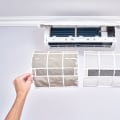
Yes — a carbon filter helps in a home where someone smokes indoors, but only if you understand what smoke actually is.
Smoke isn't a single pollutant. It's two problems in one: airborne particles and gaseous chemicals. Most filters handle the particles. Almost none handle the chemistry — and that's exactly where indoor smoking exposure becomes dangerous.
After manufacturing air filters for over a decade and helping more than two million households breathe cleaner air, we've learned that smoke is one of the most misunderstood air quality challenges a homeowner can face. The odor, the VOCs, the toxic byproducts of combustion — these aren't captured by MERV ratings alone. They require activated carbon, and they require the right system setup to make that carbon work.
This page breaks down how carbon filtration addresses smoke at the chemical level, where its limitations are, and how to combine it with the right MERV-rated filter to build a whole-home strategy that actually protects your family.
TL;DR Quick Answers
carbon filter
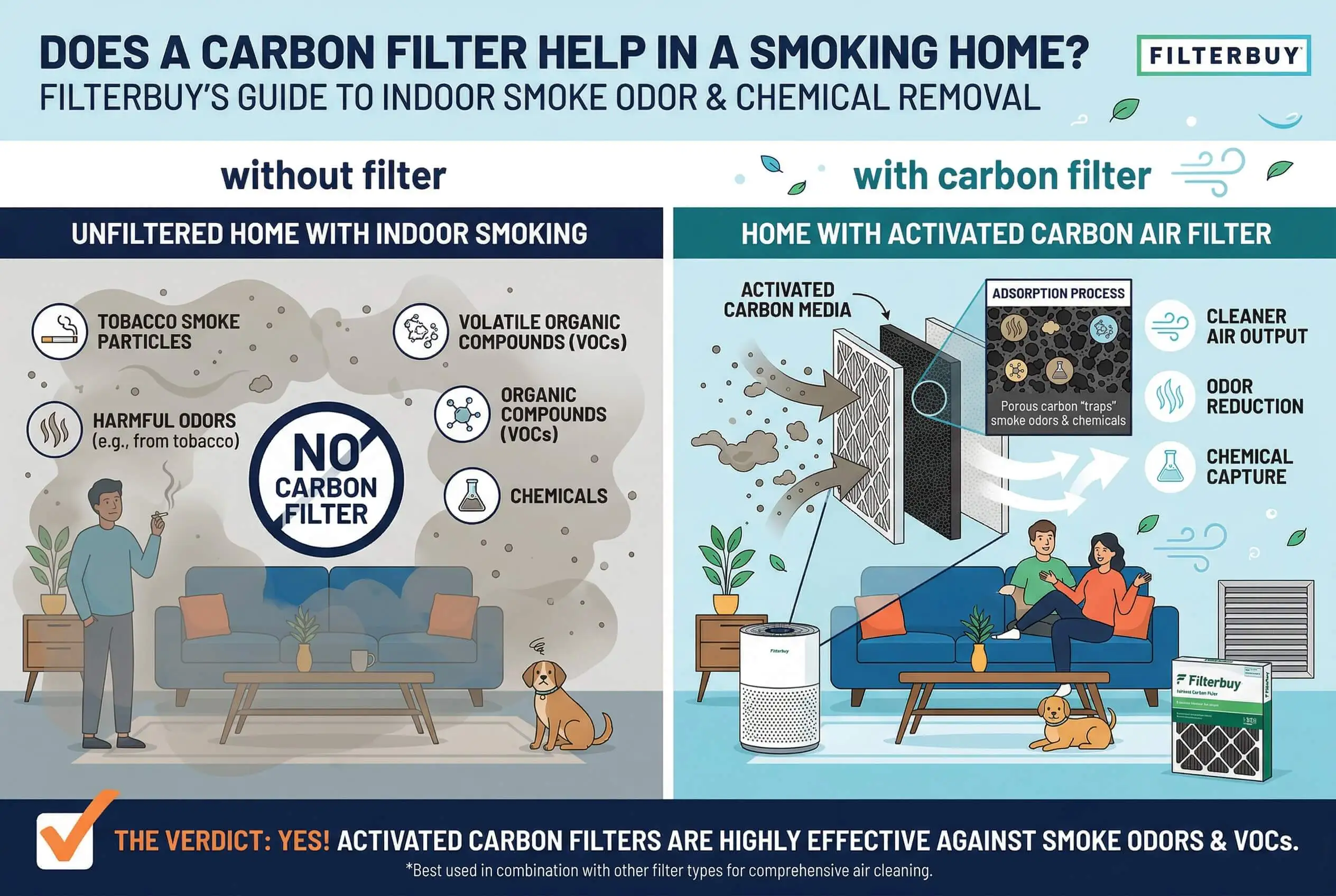
A carbon filter uses activated carbon to adsorb gases, VOCs, and odors from indoor air — including the chemical byproducts of tobacco smoke that standard MERV-rated filters cannot capture.
Key facts:
Carbon filtration targets the gaseous half of smoke — not the particle half
It works through adsorption, trapping chemical molecules in a dense network of microscopic pores
A single gram of activated carbon contains hundreds of square meters of internal surface area
Carbon does not capture fine particles like PM2.5 — a high-MERV mechanical filter is required for that
In a smoking household, carbon filters saturate faster than standard replacement schedules account for
Inspect every 45 days — replace immediately when smoke odor returns between HVAC cycles
The most effective setup pairs a carbon filter with a MERV 11 or MERV 13 mechanical filter
Carbon filtration is risk reduction — not risk elimination
After manufacturing filters for over a decade and serving more than two million households, the most important thing we can tell you about carbon filters is this: they are essential in a smoking household, but only as one layer of a complete filtration system — never as the system itself.
Top Takeaways
Smoke is a two-part problem that demands a two-part solution.
Fine particles require a high-MERV mechanical filter
Gaseous chemicals and VOCs require activated carbon
Neither technology covers what the other handles — both are non-negotiable
A MERV rating tells you nothing about chemical protection.
MERV measures particle capture efficiency only
Smoke's 7,000-plus chemicals pass straight through even the highest-rated mechanical filter
Activated carbon is the only residential filtration media designed to address that chemical load
Odor improvement is not the same as air quality improvement.
Reduced smoke smell signals the carbon is working — not that the air is clean
VOCs can persist at dangerous concentrations without any detectable odor
Never use smell as your air quality indicator in a smoking household
Replace filters on an accelerated schedule — saturated carbon stops protecting without warning.
Standard 90-day guidance was not developed for smoking households
Inspect filters at least every 45 days
A return of smoke odor between HVAC cycles means the carbon is exhausted — change it immediately
Treat filtration as a system, not a single product.
Carbon filter selection, MERV rating, replacement frequency, and portable air purifier placement are all variables in the same equation
Getting one right while ignoring the others leaves your family exposed
The biggest threats in a smoking household are the ones you cannot see, smell, or measure without the right strategy in place
What Smoke Actually Puts Into Your Air
Most people think of smoke as a smell. In reality, it's a complex chemical event happening inside your home every time someone lights up.
Indoor smoking releases two categories of pollutants simultaneously:
Particulate matter — fine solid particles and liquid droplets, including PM2.5, which are small enough to bypass your body's natural defenses and penetrate deep into lung tissue
Gaseous chemicals — volatile organic compounds (VOCs), formaldehyde, benzene, carbon monoxide, and hundreds of other toxic byproducts of combustion
This distinction matters because no single filter technology addresses both equally well. Understanding what you're dealing with is the first step to building a system that actually works.
How Activated Carbon Filtration Targets Smoke
Activated carbon works through a process called adsorption — not to be confused with absorption. Rather than soaking up pollutants like a sponge, activated carbon uses an enormous network of microscopic pores to trap gas molecules on its surface as air passes through.
A single gram of activated carbon can contain hundreds of square meters of internal surface area. That's what makes it uniquely effective against smoke's chemical signature — the odors, VOCs, and toxic gases that pass straight through standard HVAC filters unimpeded.
In our experience manufacturing filters for over a decade, activated carbon is the only residential filtration media that meaningfully addresses the gaseous side of tobacco and smoke exposure. No MERV rating — not even MERV 16 — is designed to capture gases. Carbon is doing an entirely different job.
What a Carbon Filter Cannot Do on Its Own
Carbon filtration is not a complete smoke solution by itself. Here's where it falls short:
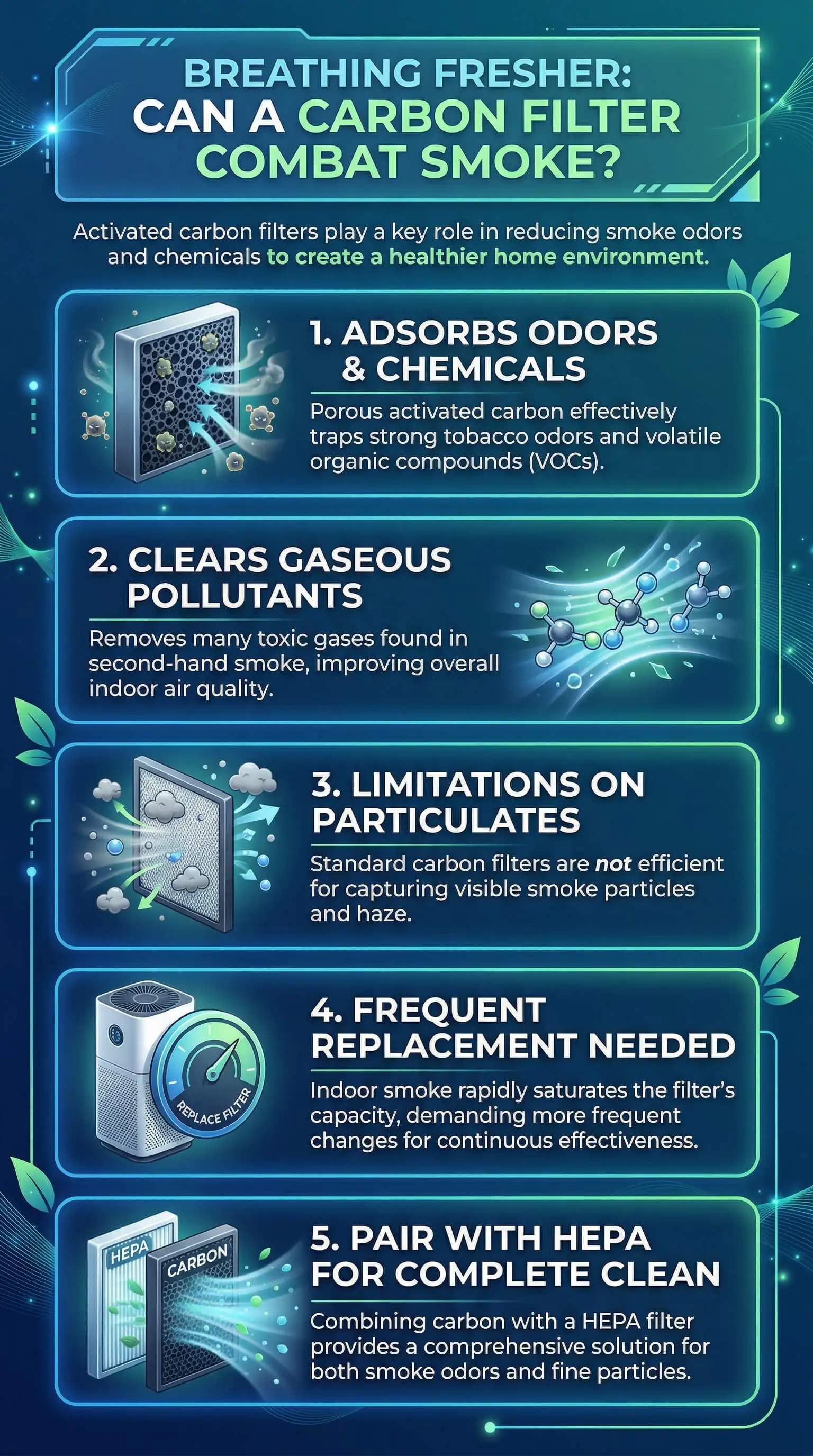
Carbon does not efficiently capture fine particles. PM2.5 — the particulate fraction most linked to serious health outcomes — requires a high-MERV mechanical filter to intercept.
Carbon media has a finite capacity. Once the activated carbon is saturated, it stops adsorbing. In a home with regular indoor smoking, carbon filters reach saturation faster than standard replacement schedules account for.
Carbon cannot remove smoke that has already embedded in surfaces. Walls, furniture, carpets, and HVAC ductwork absorb smoke compounds over time. Filtration addresses what's airborne — not what's already settled.
Treating carbon filtration as a standalone fix is one of the most common mistakes we see. It's a critical layer of protection, not the entire strategy.
Why Pairing Carbon With a MERV-Rated Filter Is Non-Negotiable
The most effective whole-home approach for a smoking household combines two technologies working in tandem:
A MERV 11 or MERV 13 filter to capture fine particles, PM2.5, and smoke aerosols
An activated carbon layer to adsorb VOCs, odors, and gaseous combustion byproducts
Filterbuy's OE With Activated Carbon filters are specifically designed around this dual-threat challenge. The carbon media handles the chemistry. The mechanical filtration handles the particles. Together, they address smoke more completely than either could alone.
For homes with heavy or frequent indoor smoking, we also recommend evaluating standalone air purifiers with HEPA and carbon stages in high-use rooms, where pollutant concentrations are highest and your HVAC system's reach is most limited.
How Often to Replace Carbon Filters in a Smoking Household
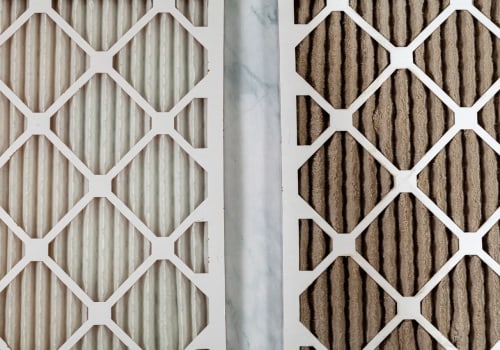
Standard filter replacement guidance does not apply in a home where someone smokes indoors. Smoke accelerates media saturation on both the carbon and particulate layers.
In our experience serving households with similar air quality challenges, a practical rule of thumb is to reduce your typical replacement interval by at least half. If you'd normally change a filter every 90 days, inspect it at 45. A visibly discolored filter or a return of smoke odors between HVAC cycles are reliable signs the carbon is exhausted and the filter needs replacing — regardless of where you are in the calendar.
"Most homeowners shopping for a smoke solution focus entirely on odor — and that's understandable, because odor is what they can detect. But odor is just the signal. The real threat is what you can't smell: the benzene, the formaldehyde, the PM2.5 particles embedding in your lungs before your brain even registers that someone lit up. After over a decade of manufacturing filters and working with millions of households, the pattern we see repeatedly is this — carbon alone quiets the complaint, but it doesn't solve the problem. The homes that manage smoke exposure most effectively are the ones running carbon and mechanical filtration together, replacing filters on accelerated schedules, and treating their HVAC system as the whole-home air management tool it was designed to be. That combination isn't a luxury. In a home where someone smokes indoors, it's the baseline."
Essential Resources
Don't take your indoor air for granted — especially when smoke is involved. After manufacturing filters for over a decade and helping more than two million households breathe cleaner air, we know that the homeowners who make the most informed filtration decisions are the ones who go beyond the product label. These seven resources give you the authoritative knowledge to build a filtration strategy that actually protects your family.
1. The EPA's Guide to Understanding How Carbon Filtration Actually Works
Most homeowners don't realize there's a fundamental difference between filters that capture particles and filters that remove gases — and smoke produces both. The EPA's Guide to Air Cleaners in the Home explains exactly how activated carbon adsorbs VOCs and chemical vapors that pass straight through standard HVAC filters, and how to choose the right combination for whole-home protection.
https://www.epa.gov/indoor-air-quality-iaq/guide-air-cleaners-home
2. What Your Filter's MERV Rating Is — and Isn't — Doing for Your Family
Here's something that surprises many homeowners: a high MERV rating addresses particles, not gases. The EPA's MERV rating resource explains what each rating level actually captures and why pairing a MERV 13 mechanical filter with activated carbon is the non-negotiable baseline for a smoking household — because no single rating covers both threats.
https://www.epa.gov/indoor-air-quality-iaq/what-merv-rating
3. The Hidden Chemical Threat in Smoke That Most Filters Were Never Designed to Catch
We make the invisible visible — and tobacco smoke's chemical signature is one of the most invisible threats in a home. The EPA's VOC resource reveals that indoor VOC concentrations can run significantly higher than outdoors, and that tobacco smoke is a primary source. This is the science behind why activated carbon exists and why odor is only the beginning of the problem.
https://www.epa.gov/indoor-air-quality-iaq/volatile-organic-compounds-impact-indoor-air-quality
4. The EPA's Honest Assessment of What Air Cleaners Can and Cannot Do for Tobacco Smoke
Protecting your family starts with knowing the limitations of your filtration tools — not just their capabilities. The EPA's guidance on air cleaners and health risks specifically addresses tobacco smoke, confirming that only filters containing activated carbon or similar media can remove the gaseous pollutants that mechanical filters are simply not built to handle.
https://www.epa.gov/indoor-air-quality-iaq/will-air-cleaners-reduce-health-risks
5. The CDC's Full Picture on What Secondhand Smoke Is Doing to the People You Love Most
At Filterbuy, we understand that maintaining your home is a way of taking care of your family. The CDC's secondhand smoke health resource puts real numbers behind that truth — including the cardiovascular disease, lung cancer, and infant SIDS risks that make filtration strategy in a smoking household a family protection decision, not just a comfort preference.
https://www.cdc.gov/tobacco/secondhand-smoke/health.html
6. Why Smoke Is More Chemically Complex Than Almost Any Other Indoor Air Challenge
Serving over two million households has taught us that most people dramatically underestimate what tobacco smoke puts into the air. The CDC's secondhand smoke overview documents more than 7,000 chemicals in tobacco smoke — hundreds of them toxic — establishing the scientific case for why smoke demands a dual-layer filtration approach that addresses both its particle and chemical components.
https://www.cdc.gov/tobacco/secondhand-smoke/index.html
7. How Filterbuy's Odor Eliminator Carbon Filters Are Built to Tackle Smoke at the Source
Our American-made Odor Eliminator filters use electrostatically charged pleated media to capture 95% of airborne particles — including smoke and smog — while the activated carbon layer adsorbs the VOCs, odors, and chemical vapors that MERV-rated filters cannot address. For homes with indoor smoking, this is the filtration combination built specifically for your challenge.
Supporting Statistics
The numbers behind indoor smoke exposure don't just support the case for carbon filtration — they redefine it. Here's what the data reveals about what's moving through the air in a smoking household, and why it matters.
Nearly 34,000 U.S. adults who do not smoke die from secondhand smoke-related heart disease every year.
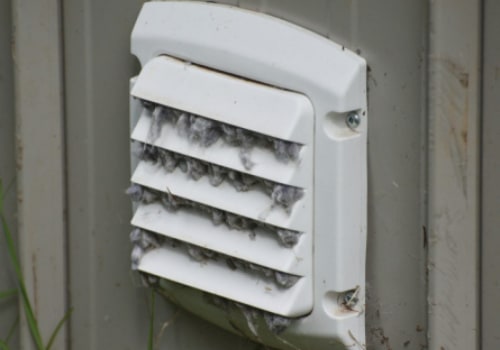
Most people approach indoor smoking as an odor problem first and a health problem second. Dryer vent cleaning reflects a similar blind spot in home maintenance, where what seems like a minor air issue often carries bigger health and safety implications than most people realize. The CDC's cardiovascular data flips that entirely.
What this statistic tells us:
Heart disease — not lung disease — is the leading cause of secondhand smoke death among nonsmokers
Carbon filters address the chemical compounds that travel deepest into the body
MERV-rated filters intercept the fine particles that drive systemic inflammation
Neither layer is optional when the stakes are this high
Source: Centers for Disease Control and Prevention — Health Problems Caused by Secondhand Smoke https://www.cdc.gov/tobacco/secondhand-smoke/health.html
Tobacco smoke contains more than 7,000 chemicals — hundreds of them toxic, and approximately 70 known or suspected carcinogens.
After manufacturing filters for over a decade and serving more than two million households, this is the statistic we return to most when helping customers understand why there is no single-filter solution to indoor smoking.
What this statistic tells us:
A MERV rating is a particle metric — it measures what a filter physically intercepts, not what it chemically neutralizes
Smoke's 7,000-compound chemical profile is the reason activated carbon was developed as a distinct filtration technology
Pairing carbon with a high-MERV mechanical filter isn't just a recommendation — the chemistry makes it obvious
Source: Centers for Disease Control and Prevention — About Secondhand Smoke https://www.cdc.gov/tobacco/secondhand-smoke/index.html
The EPA has found that indoor VOC concentrations run consistently higher than outdoors — up to ten times higher — and tobacco smoke is among the most significant contributors.
Most homeowners instinctively trust their indoor air more than outdoor air. In a home where someone smokes regularly, that assumption is inverted.
What this statistic tells us:
The VOC fraction of smoke drives elevated indoor chemical levels — and it's the fraction most homeowners are unknowingly leaving unaddressed
Standard MERV filters, standard replacement schedules, and standard filtration thinking were not built for a ten-times-higher VOC load
Activated carbon exists to manage exactly this — and accelerated replacement schedules matter as much as filter selection in smoking households
Source: U.S. Environmental Protection Agency — Volatile Organic Compounds' Impact on Indoor Air Quality https://www.epa.gov/indoor-air-quality-iaq/volatile-organic-compounds-impact-indoor-air-quality
Final Thoughts
Carbon filtration is one of the most misunderstood tools in residential air quality. Nowhere is that misunderstanding more consequential than in a home where someone smokes indoors.
Here is where most homeowners get it wrong:
They install a carbon filter
The odor improves
They conclude the problem is solved
Odor is feedback, not a measurement. The VOCs are still present. The PM2.5 is still circulating. Smoke's 7,000-compound chemical signature doesn't disappear because the smell becomes manageable. It becomes invisible again — which is exactly what makes it dangerous.
After over a decade of manufacturing filters and working with millions of households, our perspective is clear:
Carbon filtration is essential in a smoking household — but it is one layer of a system, not the system itself
The homes that manage smoke exposure most effectively treat their HVAC as a whole-home air management tool, not just a comfort appliance
Filter selection matters, but replacement frequency matters just as much — saturated carbon stops working silently, without warning
The dual-threat nature of smoke demands a dual-layer response every time
What we've seen repeatedly: the households that struggle most with indoor smoke exposure are not the ones who made the wrong filter choice. They're the ones who made only one choice.
A single carbon filter. A single replacement schedule. A single strategy for a multi-variable problem.
The CDC and EPA data leave no room for interpretation on what tobacco smoke puts into indoor air. What remains within your control is how seriously you respond to that science:
Pair carbon filtration with a high-MERV mechanical filter
Replace filters on an accelerated schedule — not the standard 90-day interval
Treat indoor air quality in a smoking household as the ongoing, active commitment it requires
Clean air in a home where someone smokes is achievable. But it requires the right combination of tools, the right replacement habits, and the understanding that the biggest threats in that air are the ones you cannot smell.
FAQ on Carbon Filters
Q: Does a carbon filter remove cigarette smoke from indoor air?
A: Yes — but only half of it. Smoke is two problems in one:
Gaseous chemicals, VOCs, and odors → activated carbon adsorbs these
Fine particles like PM2.5 → a high-MERV mechanical filter intercepts these
After manufacturing filters for over a decade, the pattern in households that manage smoke exposure most effectively is consistent:
Carbon filter — handles the chemistry
MERV 11 or MERV 13 filter — handles the particles
That combination is the baseline — not the upgrade.
Q: How long does a carbon filter last in a home where someone smokes indoors?
A: Much less than the 90 days printed on the box. Indoor smoking accelerates carbon saturation faster than almost any other household air quality challenge we've encountered.
What to do:
Inspect your filter at minimum every 45 days
Do not rely on the calendar — rely on performance signals
Replace immediately when smoke odor returns between HVAC cycles
That odor return is the most reliable sign the carbon is exhausted. In a smoking household, standard replacement schedules are a guideline for a different home.
Q: What is the difference between a carbon filter and a HEPA filter for smoke?
A: They solve different halves of the same problem. Confusing them is one of the most common mistakes we see.
HEPA filter → mechanical filtration → captures PM2.5 and smoke particles
Carbon filter → chemical filtration → adsorbs VOCs, gases, and odors
Since smoke produces both particles and gases simultaneously, the most protective setup combines both:
A carbon HVAC filter paired with a high-MERV mechanical filter in your central system
A dual-stage portable air purifier with both HEPA and activated carbon in high-exposure rooms
Neither technology alone constitutes a complete solution.
Q: Can a carbon filter eliminate secondhand smoke health risks?
A: No — and being direct about this matters. The CDC is unambiguous:
The only way to fully protect nonsmokers is to eliminate indoor smoking entirely
No filtration system — including carbon — achieves complete risk elimination
What a properly configured carbon filtration system does:
Reduces VOC and toxic gas concentrations in circulating air
Lowers the fine particle load your family breathes daily
Provides meaningful risk reduction where risk elimination is not possible
Filtration is an essential layer of protection in a smoking household — but it is mitigation, not elimination.
Q: Where should a carbon air filter be used in a home where someone smokes indoors?
A: Two places — your central HVAC system and the rooms where smoking happens most.
In your HVAC system:
Pair a carbon filter with a MERV 11 or MERV 13 mechanical filter
This treats both particles and chemical gases every time the fan runs
In high-exposure rooms:
Add a standalone portable air purifier with both a HEPA stage and an activated carbon stage
Run it continuously
Here is why the portable unit matters: most residential HVAC systems run less than 25% of total operating hours. When the system is off, it is not filtering. A portable unit in the highest-exposure room covers the hours your central system cannot.
Ready to Protect Your Home From Indoor Smoke?
If someone smokes indoors in your home, a standard filter is not enough — your family deserves a filtration strategy built for the full chemical and particle complexity of tobacco smoke. Explore Filterbuy's Odor Eliminator carbon filters and find the right size for your HVAC system today.