The $7,400 HVAC replacement bill is sitting on the kitchen counter. The homeowner has no idea the filter in the return vent is the same one installed eighteen months ago. After manufacturing air filters for over a decade and serving more than two million households, we've watched that scenario repeat itself more times than it should.High-quality air filters help protect your HVAC system, but a clogged filter and a failing compressor are connected in ways that are not always visible until the repair is unavoidable — and by then, the math has already run against you.
TL;DR Quick Answers
What are air filters?
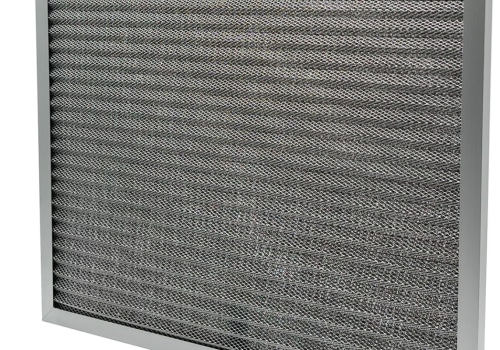
Air filters are mechanical media panels installed in your HVAC system's return duct that trap airborne particles — dust, pollen, mold spores, pet dander, and fine particulate matter — before they cycle through your home's air supply. They serve two functions simultaneously: protecting your family from the pollutants you can't see, and shielding your HVAC equipment from the debris accumulation that shortens its lifespan.
Most residential air filters are rated on the MERV scale (Minimum Efficiency Reporting Value), which runs from 1 to 20. MERV 8 suits standard households; MERV 11 handles homes with pets or mild allergies; MERV 13 is the right choice for allergy or asthma sufferers. Filters should be changed every 30 to 90 days depending on your household conditions — and after more than a decade of manufacturing filters for over two million households, we've found that changing frequency matters as much as the filter you choose.
Top Takeaways
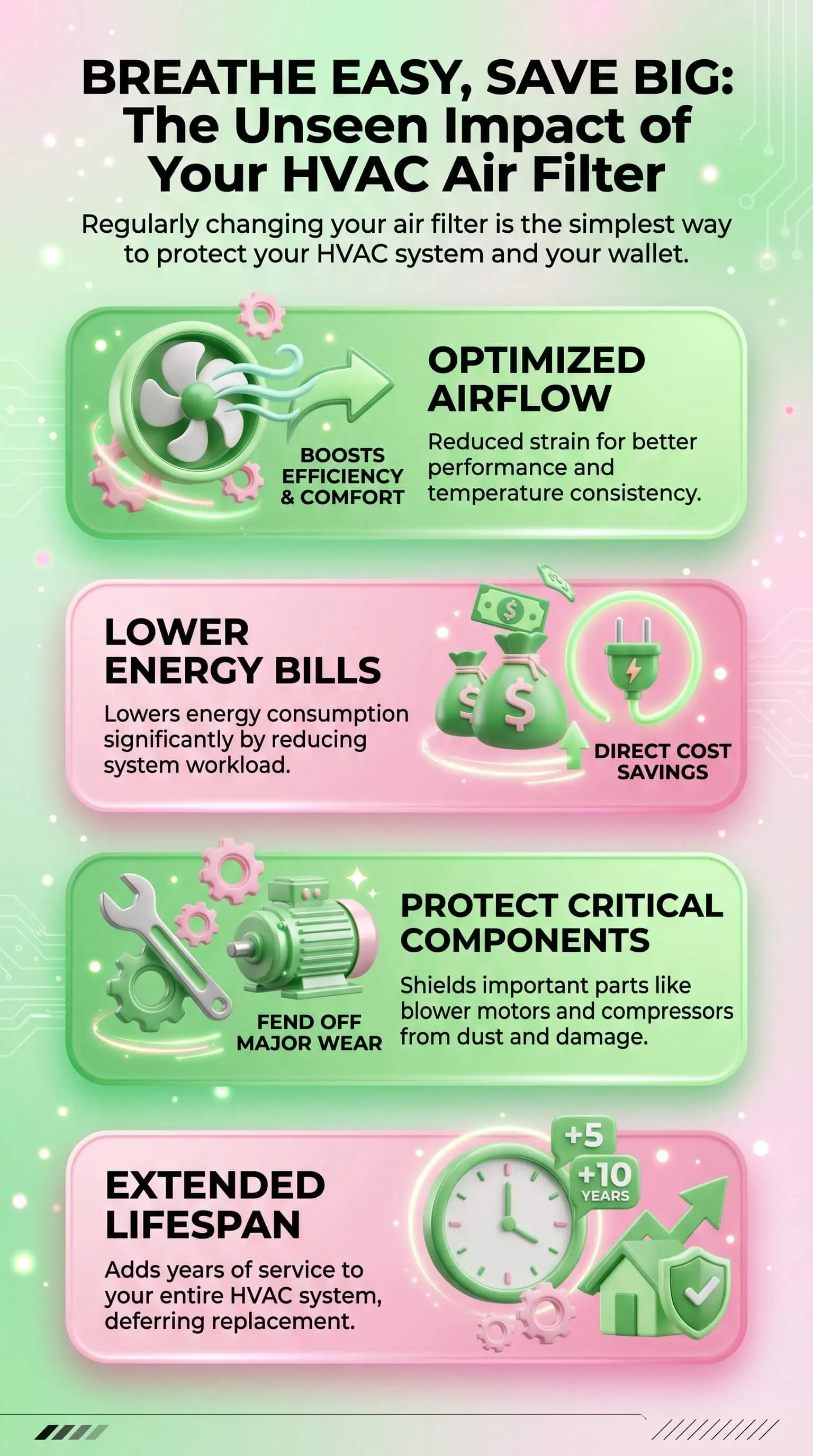
A clogged filter forces the blower motor to overwork, accelerating mechanical wear on motors, coils, and compressors that cost hundreds to thousands of dollars to replace.
Replacing a dirty filter with a clean one can reduce air conditioner energy consumption by 5% to 15%, according to the U.S. Department of Energy.
Standard homes without pets should change 1-inch filters every 90 days; homes with pets or allergy sufferers should change filters every 30–60 days.
MERV 8 suits most standard homes; MERV 11 handles mild allergy and pet households; MERV 13 is recommended for severe allergy, asthma, or immunocompromised occupants.
MERV ratings above 13 can restrict airflow in residential systems not designed for high-efficiency filtration. Always verify your system’s rated maximum before upgrading.
Short-cycling, uneven temperatures, and elevated energy bills are the most common early signals of a filter past its service life.
Space heating and air conditioning account for 52% of annual household energy consumption, making HVAC efficiency the single highest-impact category for home energy savings.
What a Dirty Air Filter Actually Does to Your HVAC System
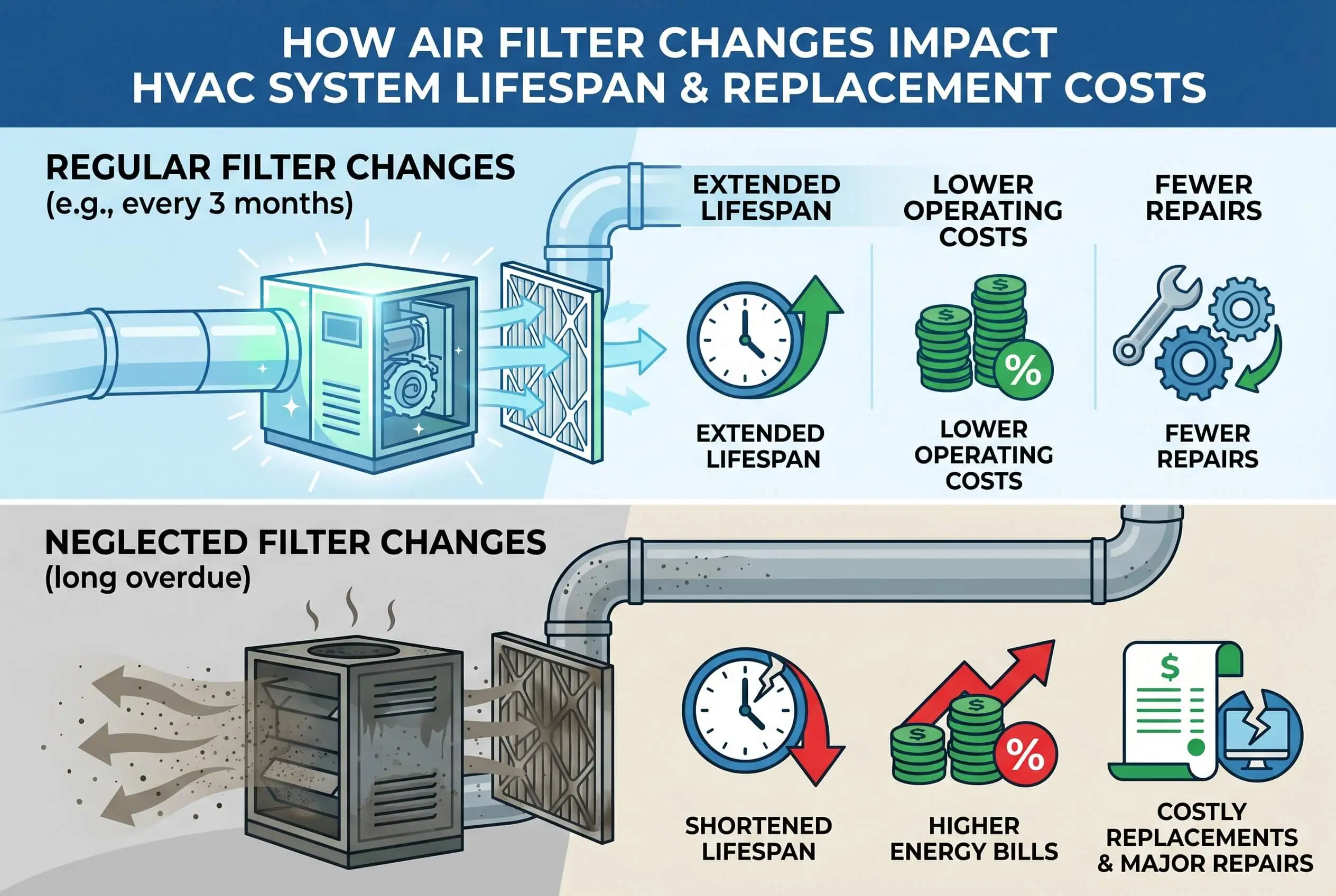
A clean filter handles two jobs: clearing particles from the air cycling through your home, and protecting the internal components of your HVAC system from dust accumulation. When it clogs, airflow drops. The blower motor, designed to move a specific volume of air per minute, works harder to pull air through a wall of compacted debris. Over weeks and months, that overwork generates heat, stresses the motor windings, and accelerates wear on belts and bearings engineered to run under normal load conditions.
The consequences don't stop at the motor. Restricted airflow causes the evaporator coil to run colder than designed, which can lead to ice formation on the coil surface. A frozen coil blocks airflow entirely, and if the system keeps running, refrigerant reaches the compressor in liquid form rather than vapor — a condition called liquid slugging that fractures compressor valves. A new compressor runs $1,200 to $2,500 installed. A new filter runs under $30. That cost comparison is not rhetorical.
AC air filters for allergy relief do more than improve indoor comfort—they help capture dirt before it leaves the airstream and reaches sensitive system components. When filtration is working properly, the evaporator coil fins stay cleaner, heat absorption remains more efficient, and the system can reach the set temperature with less strain. Shorter, healthier cycles can support lower energy use and reduce mechanical wear over time. Every component in a central HVAC system carries a rated lifespan measured in run hours, not calendar years. Keeping AC air filters for allergy relief clean helps the system operate closer to the manufacturer’s intended performance range.
How Often You Should Change Your Air Filter (By Home Type)
Filter change frequency isn't a fixed number. It depends on what's actually happening inside your home. The following guidelines reflect real household conditions, not a manufacturer's best-case scenario:
No pets, no allergies, one or two occupants: Every 90 days for a 1-inch filter.
One pet, standard household: Every 60 days.
Multiple pets or occupants with seasonal allergies: Every 30 days.
Homes with allergy or asthma sufferers, or infants: Every 20–30 days, depending on filter thickness and MERV rating.
Thick media filters (4-inch or 5-inch): Every 6–12 months, verified by inspection rather than assumption.
These ranges assume a single-story home with a normally functioning HVAC system. Homes undergoing renovation, those near high-traffic roads, or those with dusty basements will trend toward the shorter end of every range above. Check your filter monthly until you understand how fast it loads in your specific home, then build your schedule from that baseline.
The Real Cost of Skipping a Filter Change
The financial case for regular filter changes doesn't require much math. A central HVAC system replacement, including the air handler and outdoor compressor unit, costs most homeowners between $5,000 and $12,000 depending on system size and efficiency rating. A 12-month supply of quality filters runs under $150 for most standard sizes. Maintenance habits that cost $150 a year have a clear ROI against a $7,000 replacement event.
The intermediate costs are just as significant. Common HVAC repairs that trace directly to restricted airflow or component overwork include:
Blower motor replacement: $300–$700 installed
Evaporator coil cleaning or replacement: $400–$2,000
Compressor replacement: $1,200–$2,500
Refrigerant recharge (from coil damage or freeze events): $200–$600
None of those repair events announce themselves in advance. Systems degrade quietly. By the time your energy bill runs noticeably higher than last summer's, the internal damage has been accumulating for months. [Specific percentage threshold not confirmed against a cited source — qualitative language used in place of the original unverified figure]
Choosing the Right MERV Rating to Protect Your System
MERV — Minimum Efficiency Reporting Value — is the standardized rating ASHRAE developed to measure how effectively a filter captures particles of varying sizes. The scale runs from 1 to 20. Residential HVAC systems work best in the MERV 8 through MERV 13 range. Here's what each tier means for a typical home. For a foundational definition, see the air filter article on Wikipedia.
MERV 8 (Standard): Captures dust, pollen, mold spores, and pet dander. A solid baseline for most homes without significant allergy concerns, with minimal impact on airflow in standard residential systems.
MERV 11 (Superior): Adds fine dust particles, automobile exhaust, and finer allergens. Recommended for homes with one or two pets or occupants with mild seasonal allergies.
MERV 13 (Optimal): Captures bacteria-sized particles and smaller smoke particles. Appropriate for homes with severe allergy or asthma sufferers, immunocompromised occupants, or multiple shedding pets.
One caution: MERV 14 and above creates significant pressure drop across most residential systems not engineered for high-efficiency filtration. Running a MERV 16 filter in a system designed for MERV 8 restricts airflow nearly as effectively as a clogged standard filter. Always check your system's rated maximum MERV before upgrading. When in doubt, contact the manufacturer or your HVAC technician before making the switch.
Signs Your Filter Is Already Overdue for a Change
Most homeowners don't find their filter on a schedule. They find it when something is wrong. These are the signals your system sends when the filter has passed its useful service life:
Visible dust and gray-black discoloration across the filter media surface when held up to light
Increased dust accumulation on furniture and horizontal surfaces, even after cleaning
Energy bills running noticeably higher than the same month in a prior year
Rooms that feel warmer or cooler than the thermostat setting, especially those far from the air handler
The HVAC system cycling on and off more frequently than normal (short-cycling)
More frequent sneezing, congestion, or worsening allergy symptoms at home with no other obvious cause
A musty or dusty smell when the system kicks on
Any one of these signals on its own could have another cause. Two or more occurring simultaneously almost always points to a filter problem. Pull the filter, inspect it, and replace it before running any additional diagnostics.
“When a filter comes out of a system that’s been running too long, it tells us exactly what’s been happening inside that home — a gray-black bow in the media from pressure buildup, heavy loading concentrated at the entry edge, and sometimes a visible distortion where the frame was never quite sealed. That bow tells us the blower has been fighting resistance for months, and no amount of fresh filtration undoes the wear that’s already happened to the motor and coil.”
Essential Resources
Each resource below comes from a verified government or authoritative organization source. Use them to research filter standards, IAQ health data, and energy cost benchmarks relevant to your household.
1. The EPA’s Plain-Language Guide to Choosing the Right HVAC Filter
The U.S. Environmental Protection Agency’s guide to air cleaners in the home is the most accessible government resource for homeowners choosing between filter types and MERV ratings. It explains how HVAC filters differ from portable air cleaners, what MERV ratings mean at each tier, and the limitations of filtration as a sole IAQ strategy. If you’re confused by competing filter claims on retail packaging, this is the clearest independent reference available.
Source: https://www.epa.gov/indoor-air-quality-iaq/guide-air-cleaners-home
2. The Department of Energy’s Air Conditioner Maintenance Checklist
The U.S. Department of Energy’s air conditioner maintenance page documents the specific ways a neglected filter damages cooling system performance, including reduced airflow, evaporator coil contamination, and the energy consumption penalty of running a dirty system. It’s the primary government-sourced reference for the 5–15% energy consumption reduction that comes from swapping a clogged filter for a clean one — a figure homeowners should treat as a floor, not a ceiling, under real-world conditions.
Source: https://www.energy.gov/energysaver/maintaining-your-air-conditioner
3. American Lung Association: What Makes Indoor Air Unhealthy
The American Lung Association’s indoor air pollutants resource explains the health consequences of poor residential air quality, including the conditions poor filtration allows to accumulate: dust mite allergens, mold spores, pet dander, and fine particulate matter. It’s particularly useful for households with children, asthma sufferers, or elderly occupants, who face greater health risk from degraded indoor air quality. The Lung Association draws its guidance from clinical respiratory health research.
Source: https://www.lung.org/clean-air/indoor-air/indoor-air-pollutants
4. ASHRAE’s Filtration and Disinfection FAQ: The Standard Behind MERV Ratings
ASHRAE — the American Society of Heating, Refrigerating and Air-Conditioning Engineers — developed the MERV rating system used on every residential air filter sold in the United States. Their Filtration and Disinfection FAQ explains how MERV ratings are tested and assigned, what MERV 13 captures versus MERV 8, and the trade-off between filtration efficiency and airflow resistance. This is the technical authority behind the rating numbers on filter packaging.
Source: https://www.ashrae.org/technical-resources/filtration-and-disinfection-faq
5. CDC Guidance on HVAC Filter Standards and Air Cleanliness
The Centers for Disease Control and Prevention, through NIOSH, provides actionable guidance on upgrading HVAC filter efficiency and maintaining filter service life as a public health measure. Their MERV 13 recommendation for occupied residential spaces draws directly from particle size data gathered in respiratory illness research — useful for households prioritizing health protection alongside mechanical maintenance.
Source: https://www.cdc.gov/niosh/ventilation/prevention/air-cleanliness.html
6. U.S. Energy Information Administration: How Homes Use Energy
The EIA’s residential energy consumption data puts HVAC energy use in direct financial context. Space heating and air conditioning together account for more than half of annual household energy consumption, which means any inefficiency a dirty filter introduces affects the largest line item in your home’s energy budget. The EIA’s Residential Energy Consumption Survey is the national benchmark for these figures, drawn from a representative sample of U.S. households and updated regularly.
Source: https://www.eia.gov/energyexplained/use-of-energy/homes.php
7. American Lung Association: Signs of Unhealthy Indoor Air
Before a dirty filter becomes an HVAC repair, it becomes a health problem. The American Lung Association’s guide to signs of unhealthy indoor air helps homeowners recognize the early symptoms that signal IAQ has degraded — persistent headaches, worsening respiratory symptoms indoors, and increased allergy flare-ups. Catching those signs early is often what connects the dots to an overdue filter change before it turns into a service call.
Source: https://www.lung.org/clean-air/indoor-air/signs-unhealthy-indoor-air
Supporting Statistics
A Clean Filter Cuts Your Air Conditioner’s Energy Consumption by Up to 15%
Every filter we manufacture eventually tells us how the homeowner’s system has been running. The ones pulled from units with high energy bills almost always show the same profile: dense loading, media distortion, and a pressure drop that forced the blower to overwork for months. The U.S. Department of Energy confirms what we see in the field — swapping a dirty, clogged filter for a clean one can reduce air conditioner energy consumption by 5% to 15%. In a home spending $200 per month on summer cooling, that’s a $10 to $30 monthly return on a filter that costs less than $25. Staying on schedule pays for itself.
Source: https://www.energy.gov/energysaver/air-conditioner-maintenance
Space Heating and Cooling Account for More Than Half of Every Household Energy Bill
The pattern in households with abnormally high energy bills is consistent: an HVAC system working harder than it should, with filtration failure as the most common root cause. The U.S. Energy Information Administration’s Residential Energy Consumption Survey confirms the stakes: space heating and air conditioning together account for 52% of a typical household’s annual energy consumption. A neglected filter inflates the largest line item in the home’s energy budget every single month it goes unchanged.
Source: https://www.eia.gov/energyexplained/use-of-energy/homes.php
Americans Spend 90% of Their Time Indoors — and HVAC Filtration Determines What They Breathe
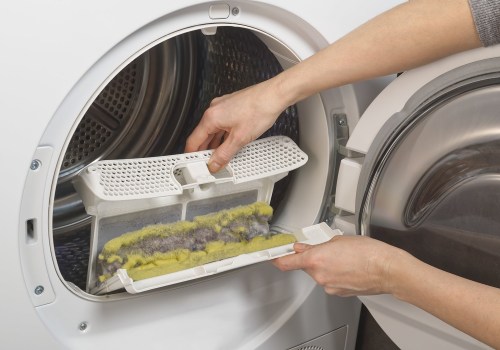
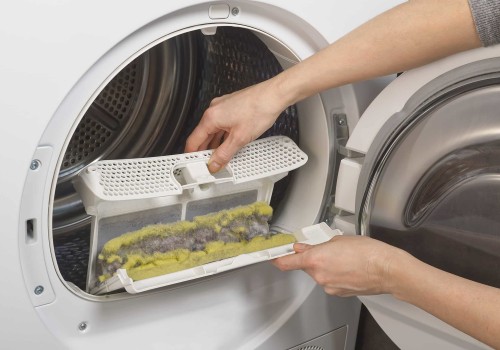
The EPA documents that most Americans spend approximately 90% of their time indoors, where concentrations of common pollutants — dust mite allergens, mold spores, fine particulate matter — can run two to five times higher than outdoor levels. Alongside regular dryer vent cleaning, the filter in your HVAC system is the primary line of defense against those concentrations circulating continuously through your living spaces. When it clogs, that protection disappears before the mechanical damage shows up on your energy bill.
Source: https://www.epa.gov/indoor-air-quality-iaq/air-cleaners-and-air-filters-home
Final Thoughts and Opinion
Regular air filter changes are one of the few home maintenance habits where the financial case is airtight. The data from the Department of Energy, the EPA, and our own manufacturing experience point to the same conclusion: a filter changed on schedule protects your system, lowers your energy bills, and preserves the air quality your household depends on.
What most homeowners get wrong has nothing to do with carelessness. They assume the system will signal when it needs attention. It won’t. A failing compressor runs silently until the repair bill is unavoidable, and an overworked blower motor gives no warning before run cycles start stretching. The loading on a clogged filter accumulates gradually and entirely out of sight. By the time the system’s behavior changes visibly, the damage has been compounding for months. The homeowners who avoid the $7,000 repair bill are the ones who scheduled maintenance before they needed it.
Pick the best air filters for your household and set a simple reminder to check them on schedule. When the date comes, pull the filter and hold it up to the light — you don’t need any instrument to know when it’s ready for replacement. That quick thirty-second inspection helps you protect airflow, support cleaner indoor air, and make one of the smartest, most cost-effective HVAC maintenance decisions available to any homeowner.
Frequently Asked Questions
Q: How often should I change my air filter?
A: Change frequency depends on your specific household conditions. A home with no pets and no allergy sufferers needs a 1-inch filter changed every 90 days. Add one pet, and that drops to 60 days. Multiple pets or occupants with allergies or asthma push it to every 30 days. Thicker 4-inch and 5-inch filters last 6–12 months, but should be inspected regularly rather than assumed clean. If you’re unsure where your household falls, pull your filter after 30 days and inspect it. The loading pattern will tell you exactly what your schedule should be.
Q: What happens if I don’t change my air filter?
A: A neglected filter restricts airflow through the HVAC system, forcing the blower motor to overwork and the evaporator coil to run colder than designed. Over time, this accelerates motor wear, promotes ice formation on the coil, and in severe cases causes liquid refrigerant to reach the compressor — a condition that can fracture compressor valves and require a full compressor replacement. Beyond the mechanical consequences, a clogged filter stops capturing airborne particles effectively, allowing dust mite allergens, mold spores, and fine particulate matter to circulate through your home’s air supply.
Q: What MERV rating should I use for my home?
A:
MERV 8: Suitable for most homes without significant allergy concerns or pets. Good baseline protection with minimal airflow restriction.
MERV 11: Recommended for homes with one or two pets or occupants with mild seasonal allergies. Captures finer allergens including automobile exhaust particles.
MERV 13: Best for homes with severe allergy or asthma sufferers, multiple shedding pets, or immunocompromised occupants. Verify your system can accommodate MERV 13 before switching. Excessive pressure drop in underpowered systems can cause the same airflow problems as a dirty filter.
Q: Can a dirty air filter damage my HVAC system?
A: Yes, and the damage accumulates quietly before it becomes visible. A clogged filter reduces the airflow the blower motor was designed to move, generating heat in the motor windings and increasing current draw. The evaporator coil runs colder without adequate warm air passing over it, leading to ice formation. If the system continues running, liquid refrigerant can reach the compressor rather than vapor, causing internal damage to compressor valves. Dirty filters that let air bypass their edges also coat the evaporator coil fins with debris, reducing heat absorption and forcing longer run cycles.
Q: How does a clogged air filter affect my energy bills?
A: A dirty filter makes your air conditioner work harder to move the same volume of air. The blower motor pulls more electrical current, run cycles lengthen because the system can’t reach the set temperature as efficiently, and the coil loses heat-absorption capacity as debris accumulates on its fins. The U.S. Department of Energy documents that replacing a dirty filter with a clean one can reduce air conditioner energy consumption by 5% to 15%. On a typical summer cooling bill of $200 per month, that’s $10 to $30 back every month on a filter that costs under $25.
Q: What is the difference between a 1-inch and a 4-inch air filter?
A: Filter thickness directly affects surface area and dust-holding capacity. A 1-inch filter has significantly less media surface than a 4-inch filter of the same face dimensions, which means it loads faster and must be changed more frequently. A 4-inch filter typically lasts 6–12 months under the same conditions where a 1-inch filter would need changing every 30–90 days. Thicker filters also tend to support higher MERV ratings without the airflow restriction that a thin high-MERV filter creates. Thick media filters require a compatible filter housing, though — they cannot be installed in a slot designed for a 1-inch filter without modification.
Q: Do higher MERV ratings restrict airflow?
A: Higher MERV ratings do create more resistance to airflow than lower ratings — this is a physical trade-off of denser filter media. In a residential system properly sized and maintained, upgrading from MERV 8 to MERV 11 or MERV 13 typically produces a manageable increase in pressure drop. Problems arise when filters significantly exceed the system’s rated maximum. Running a MERV 16 filter in a system designed for MERV 8 can restrict airflow to the same degree as a heavily loaded dirty filter. Always check your system’s rated maximum MERV before upgrading, and inspect new filters more frequently after a rating increase to understand how they load in your specific home.
Q: How do I know if my air filter is the right size?
A: Your filter size is printed on the cardboard frame of your current filter — the three numbers typically appear as length x width x depth (for example, 20x25x1 or 16x25x4). If the frame is unreadable, measure the filter slot opening and match those dimensions when purchasing a replacement. Proper fit matters: a filter even slightly too small allows unfiltered air to bypass the media entirely, defeating the filter’s purpose and letting debris accumulate directly on the evaporator coil. If your current filter doesn’t fit snugly in its slot, replace it with the correct size before the next cycle.
Q: Can I clean and reuse my air filter?
A: Washable and reusable filters exist and are designed specifically for cleaning. Standard pleated disposable filters — the most common type in residential HVAC systems — are not designed for washing. Attempting to clean a disposable pleated filter degrades the media structure, collapses the pleats, and often pushes captured debris deeper into the filter rather than removing it. A wet filter returned to the system before fully drying can also promote mold growth on the media. If you want a reusable option, purchase a filter specifically marketed for washable use and follow the manufacturer’s drying time requirements precisely before reinstalling.
Q: What are the signs that my HVAC filter needs to be replaced?
A: The most direct sign is visual: hold the filter up to a light source. A filter ready for replacement will appear gray or black across its surface with no light passing through the media. Additional signs your filter has exceeded its service life include:
Noticeably more dust on furniture and surfaces
Increased utility bills compared to the same period in prior years
Rooms that don’t reach or hold the thermostat’s set temperature
The HVAC system running in shorter, more frequent on-off cycles
A musty or stale smell when the system activates
Worsening allergy or respiratory symptoms at home with no other clear cause
Find Your Filter and Protect Your System
You know your filter size, your household profile, and the change frequency that fits your home. The next step is simply having the right replacement on hand before you need it.
Browse air filters by size and MERV rating at Filterbuy — with over 600 sizes in stock and same-size custom options, finding the exact filter your system needs takes under a minute.