We are Dr. Ruslan Maidans and Dr. Yalda Shahriari — emergency physicians, parents, and the founders of NOWATA™. We built this product because the clinical answer to hand hygiene for children was clear, and the consumer market had not caught up to it.
Here is what we knew before we started formulating:
Children's skin is more permeable than adult skin until approximately age five — meaning whatever goes on their hands absorbs differently than it does on yours
Alcohol is a documented ingestion and skin barrier risk in young children, flagged by both the CDC and the American Academy of Pediatrics
The germs most likely to shut down a classroom — norovirus chief among them — cannot be touched by alcohol at all
Killing germs leaves residue behind. Removing them does not.
Conventional sanitizers were built around adult biology, adult behavior, and a kill-rate metric that was never designed with a three-year-old in mind. Non-alcoholic hand sanitizer for kids introduces a child-centered approach to hand hygiene, designed to keep children’s hands clean safely while respecting the needs of their developing skin and everyday habits.
That question is what NOWATA™ was built to answer. This page explains the science behind it.
TL;DR Quick Answers
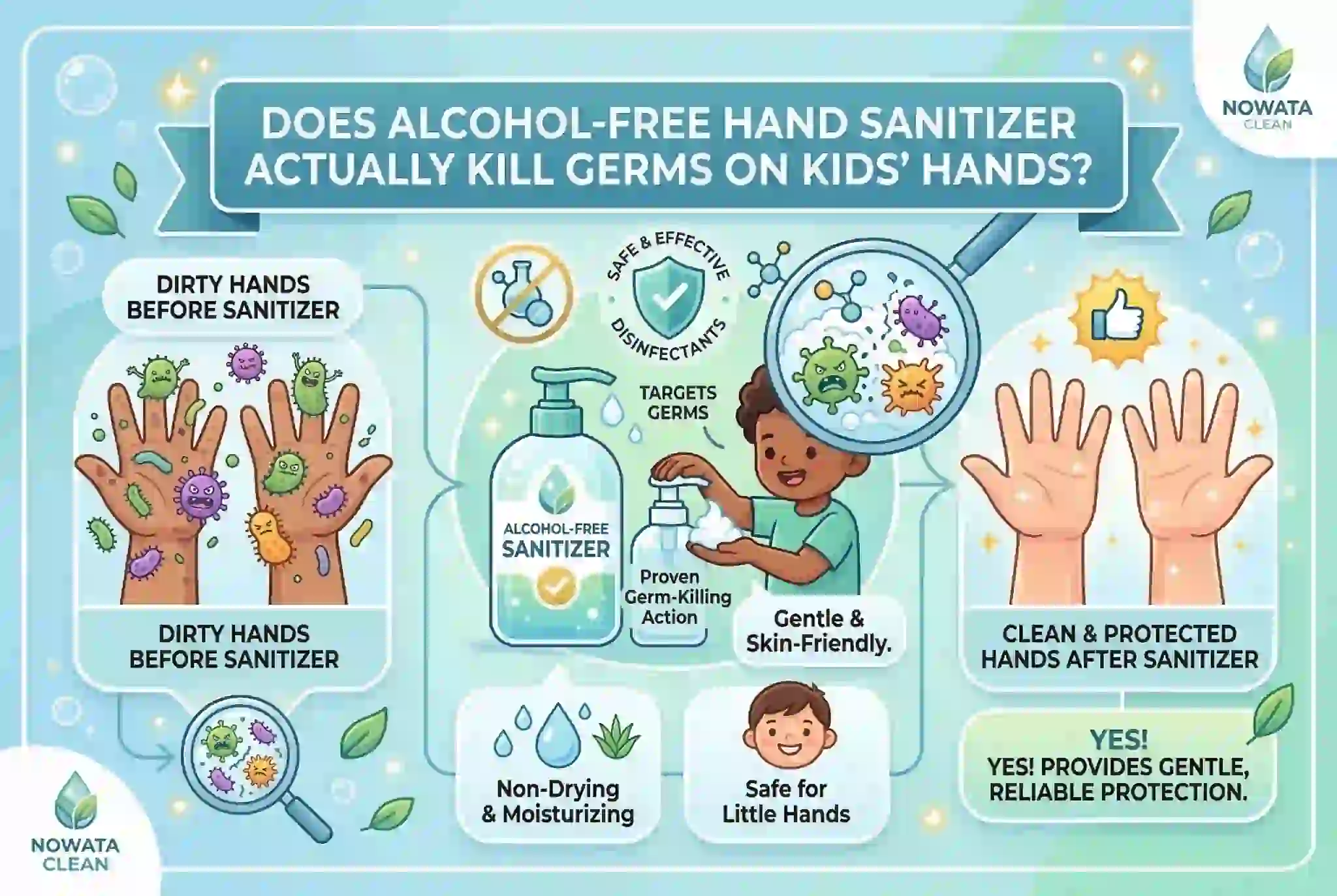
Does Alcohol-Free Hand Sanitizer Actually Kill Germs on Kids' Hands?
The better ones don't kill germs. They remove them. For children, that distinction is the whole point.
What parents need to know:
Alcohol-based sanitizers cannot neutralize norovirus — the pathogen behind most school and daycare illness outbreaks — at any concentration
Physical removal eliminates pathogens entirely, leaving no residue, dead cells, or chemical byproducts on skin
Children's skin barrier does not reach adult-level function until approximately age five — meaning whatever touches their hands absorbs differently than it does on yours
Kill-rate percentages on sanitizer labels do not disclose what the product misses — and what it misses most is what children encounter most
The CDC recommends physical removal via soap and water when alcohol fails — NOWATA™ delivers that mechanism portably, without a sink
The bottom line: the best alcohol-free hand sanitizer for kids physically removes germs rather than leaving chemical residue behind, works against pathogens alcohol cannot touch, and is formulated around children's biology — not adapted from an adult standard. NOWATA™ was independently tested using a modified ASTM E1174 protocol and verified at 99.9% removal of germs, dirt, and oil — built by physician-parents who could not find a clinically defensible option on any shelf, so they developed it themselves.
Top Takeaways
1. Killing Germs and Removing Germs Are Not the Same Thing
Alcohol kills some pathogens but leaves residue and dead cells on skin
Physical removal eliminates the pathogen — nothing left behind
Removal is safer and more complete for children
NOWATA™ is built around removal, not killing
2. Alcohol Sanitizer Has Zero Efficacy Against the Pathogen Most Likely to Close Your Child's Classroom
Norovirus drives 19–21 million U.S. cases annually
Norovirus is nonenveloped — alcohol cannot penetrate its protein shell at any concentration
Annual pediatric burden: 24,000 hospitalizations, 132,000 ER visits, 925,000 outpatient visits
Every alcohol sanitizer on a school wall offers zero protection against this pathogen
3. The 99.9% Kill Rate on the Label Does Not Tell You What the Product Misses
Kill-rate claims exclude norovirus, rotavirus, and C. difficile
Labels are not required to disclose efficacy gaps
Parents are making decisions based on incomplete information by design
We built NOWATA™ because we could not defend conventional sanitizers in a clinical conversation
4. Effective Hand Hygiene Reduces School Absenteeism by 29–57% — But Only If the Product Works
CDC data confirms proper hand hygiene reduces GI illness absenteeism by 29–57%
That benefit disappears when the product has no efficacy against the pathogen driving the outbreak
Physical removal is what the CDC recommends when alcohol fails
NOWATA™ delivers that mechanism portably — no sink required
5. Parents Deserve the Complete Information — Not Just the Number on the Front of the Bottle
Conventional sanitizers were not designed around children's biology or most common pathogens
The industry built its category around a metric that was never designed with children in mind
We spent two years in development refusing to release something we couldn't clinically defend
NOWATA™ is the product we wished existed before we had to build it ourselves
The Question Parents Are Actually Asking
When parents search for alcohol-free hand sanitizer for kids, they are not asking an abstract chemistry question. They are standing in a store aisle, reading a label, and trying to decide whether a product without alcohol can actually do the job. The answer requires understanding one thing first: what "the job" actually is.
Hand hygiene has two mechanisms — killing pathogens and removing them. The hand hygiene industry built its marketing around killing because kill-rate percentages are easy to print on a label. What those numbers do not show is what gets left behind, what they miss entirely, and what repeated exposure to the killing agent does to a child's skin over time.
Killing Germs vs. Removing Them — Why the Difference Matters for Children
Alcohol-based sanitizers denature proteins in bacterial cell walls, which kills many common pathogens on contact. That is the mechanism, and it works — on the germs alcohol can reach, on skin that can tolerate repeated alcohol exposure, and in situations where the pathogens in question respond to alcohol at all.
For children, each of those conditions is compromised:
Young children's skin barrier is more permeable than adult skin, increasing absorption of alcohol and any co-ingredients with every application
Repeated alcohol exposure strips the skin's natural lipid barrier, compounding damage in children who are already reactive
Alcohol has no effect on norovirus, rotavirus, or Clostridioides difficile — pathogens that circulate routinely in schools, daycares, and pediatric clinical settings
Physical removal works differently. A formula that lifts and carries germs, dirt, and oil away from the skin surface does not need to penetrate the pathogen to neutralize it — it removes the pathogen entirely, following the same skin-friendly approach used in hypoallergenic hand soap. No residue. No chemical byproduct on the skin. No gap for the germs alcohol cannot touch.
Why Children's Biology Changes the Calculus Entirely
Adult hand hygiene standards were developed for adult skin. The assumption that children's products are simply scaled-down adult products is one of the most consequential oversights in the consumer hygiene market.
NIH-published research is unambiguous on this point:
Children's skin barrier does not reach adult-level function until approximately age five
The stratum corneum in young children is thinner, less compact, and loses water at significantly higher rates than adult skin
Greater permeability means greater absorption of every ingredient applied topically — including alcohol, synthetic fragrance, and preservatives
A product that is clinically acceptable for an adult's hands may be clinically inappropriate for a toddler's. That is not a fringe position. It is the position the American Academy of Pediatrics, the CDC, and peer-reviewed dermatological research all arrive at independently.
The Germs Alcohol Cannot Touch — and Where Children Encounter Them Most
This is the part of the conversation the hand hygiene industry has been slow to have with parents. Alcohol-based sanitizers have well-documented efficacy gaps — pathogens they cannot neutralize under any concentration or contact time.
The CDC confirms alcohol-based sanitizers are ineffective against:
Norovirus — the leading cause of gastrointestinal illness outbreaks in schools and daycares
Rotavirus — a leading cause of severe diarrhea in young children
Clostridioides difficile — increasingly present in community settings, not just hospitals
These are not rare pathogens. They are the ones most likely to trigger the illness outbreaks that send children home from school in waves. A sanitizer that cannot touch them is not a complete solution — regardless of what its kill-rate percentage says on the front of the bottle.
What Alcohol-Free Hand Sanitizer Should Actually Do
Not all alcohol-free formulas are created equal. Removing alcohol solves one problem. What replaces it determines whether the product actually works.
A clinically sound alcohol-free hand sanitizer for children should:
Physically remove germs, dirt, and oil from the skin surface — not simply mask or suppress them
Carry independent laboratory testing against a recognized efficacy standard
Contain no synthetic fragrance, parabens, or harsh preservatives that compromise the skin barrier
Work without water — because the moments that require hand hygiene most often are the moments when a sink is not available
Be safe if a young child contacts their mouth before the product fully absorbs
NOWATA™ was formulated to meet every one of those criteria. Plant-based clumping technology physically lifts contaminants from the skin surface and carries them away. Independent efficacy testing was conducted using a modified ASTM E1174 protocol by Microbe Investigations AG in Switzerland. No alcohol. No synthetic fragrance. No ingredients we would not defend in a clinical setting.
The Standard We Held Ourselves To
We did not build NOWATA™ by asking what we could get away with on a label. We built it by asking what we would be comfortable recommending to the parents sitting across from us in the exam room — parents who trusted us to tell them the truth about what was safe for their child.
That standard did not allow for alcohol. It did not allow for synthetic fragrance. It did not allow for the assumption that a children's product could be built on an adult template and called good enough.
Alcohol-free hand sanitizer does not just kill germs on kids' hands. The best version of it removes them — completely, safely, and without leaving anything behind that a child's skin or developing biology was never designed to handle.
"Parents ask us whether alcohol-free sanitizer actually works. We ask them a different question: works compared to what? Alcohol-based sanitizers miss norovirus entirely — the pathogen most likely to shut down your child's classroom. They leave chemical residue on skin that, in children under five, absorbs topical ingredients at a fundamentally different rate than adult skin does. And they were never tested with a toddler's behavior in mind — a child who touches their face before the product dries, every single time. We spent two years in development not because the plant-based science was difficult, but because we refused to release something we could not stand behind in a clinical conversation with a parent. Every ingredient in NOWATA™ was evaluated the way we evaluate a treatment recommendation — against the biology of the patient it is actually intended for. In this case, that patient is a child. That changes everything about what acceptable looks like."
Essential Resources
7 Sources We Read Before We Built NOWATA™ — and That Every Parent Deserves to Read Before Buying a Sanitizer
1. The Federal Document That Explains Why "Kills 99.9% of Germs" Is Not the Whole Story The CDC draws a direct line between killing germs and removing them — and identifies by name the pathogens that alcohol cannot neutralize at any concentration. This is the document that reframes the entire conversation around what effective hand hygiene actually means. https://www.cdc.gov/clean-hands/about/hand-sanitizer.html
2. The One Page That Explains Why Your Child's Classroom Keeps Getting Sick The CDC states it plainly: alcohol-based sanitizers do not work against norovirus — the pathogen responsible for the majority of illness outbreaks in schools and daycares. We read this early. It confirmed what we were already seeing in our patients. It belongs in front of every parent choosing a sanitizer for a child. https://www.cdc.gov/norovirus/prevention/index.html
3. The Kill-Rate Data the Front of the Bottle Was Not Designed to Show You Behind every percentage claim on a sanitizer label is a list of what that percentage does not cover. The CDC's fact-based breakdown documents the efficacy gaps, the missed pathogens, and the conditions under which sanitizer effectiveness drops — context that changes how parents read a product label. https://www.cdc.gov/clean-hands/data-research/facts-stats/hand-sanitizer-facts.html
4. What Pediatricians Know About Alcohol Sanitizer and Young Children That Most Parents Don't The American Academy of Pediatrics does not equivocate on this. Ingestion risk is documented, poison control data is cited, and the age-based safety thresholds are clear. As clinicians, we were trained on this guidance. As parents, we think every family deserves access to it before they hand a bottle to a child under five. https://publications.aap.org/aapnews/news/11661/Keep-hand-sanitizers-out-of-children-s-reach
5. The AAP's Direct-to-Parent Guide on What to Check Before Any Sanitizer Touches Your Child's Hands HealthyChildren.org covers recalled products, toxic ingredient risks, and the supervision requirements that most sanitizer packaging buries in fine print. It is the resource the AAP built for parents — not clinicians — and it is worth reading in full before making a purchase decision. https://www.healthychildren.org/English/health-issues/conditions/COVID-19/Pages/Keep-Hand-Sanitizer-Out-of-Childrens-Reach.aspx
6. What the FDA Knows About What Has Already Made It Into Children's Sanitizer Products Federal guidance on ingredient risks, labeling requirements, and recalled formulations — including products containing methanol that reached consumer shelves. We pulled ingredient labels throughout our development process. This is the regulatory record of what we found and why it mattered. https://www.fda.gov/consumers/consumer-updates/safely-using-hand-sanitizer
7. The Biology That the Hand Hygiene Industry Built Its Products as Though It Did Not Exist NIH-published research confirms what we knew as clinicians and had to account for as formulators: infant and young children's skin is measurably more permeable than adult skin, with barrier function that does not reach adult levels until approximately age five. This is not a minor footnote. It is the reason NOWATA™ exists. https://pmc.ncbi.nlm.nih.gov/articles/PMC11791375/
Supporting Statistics
Stat 1: Approximately 19 to 21 Million Cases of Norovirus Occur in the U.S. Every Year — and Alcohol Sanitizer Cannot Touch a Single One of Them
We were not researchers who found this in a literature review. We were emergency physicians who watched the same outbreak cycle repeat — same schools, same daycares, same families — season after season.
The CDC scale:
~19–21 million norovirus cases annually in the U.S.
Norovirus accounts for 68% of all identified gastroenteritis outbreaks
Schools and childcare centers appear as consistent, recurring outbreak settings every year
The part that stayed with us was not the volume. It was the mechanism:
Norovirus is nonenveloped — alcohol cannot penetrate its protein shell
Not at 60% concentration. Not at 95%. Not under any contact time a child actually holds still for
Every alcohol sanitizer dispenser on a school hallway wall offers zero protection against the pathogen most likely to cause the next outbreak
We stopped asking how to make alcohol work against norovirus. We started building a product that could actually remove it.
Source: https://www.cdc.gov/norovirus/outbreak-basics/index.html Source: https://pmc.ncbi.nlm.nih.gov/articles/PMC6814392/
Stat 2: Norovirus Drives 24,000 Hospitalizations, 132,000 Emergency Room Visits, and 925,000 Outpatient Visits in U.S. Children Every Year
We did not read these numbers from behind a desk. We saw them arrive through our emergency department doors — dehydrated toddlers who could not hold fluids, parents awake for thirty hours, families who had no idea the sanitizer in their child's backpack had done nothing.
The pediatric burden by the numbers:
24,000 hospitalizations in children under 18 annually
132,000 emergency room visits
925,000 outpatient visits
Estimated annual cost: more than $200 million
What those numbers do not show is the visit before the visit — the parent who used the sanitizer, followed the guidance, did everything right, and still ended up in our waiting room.
The product they trusted did not work against the pathogen responsible. Physical removal is what the CDC recommends when alcohol fails. We built NOWATA™ to deliver that mechanism portably — without a sink — in the exact moments conventional products fall short.
Source: https://pmc.ncbi.nlm.nih.gov/articles/PMC6814392/ Source: https://www.cdc.gov/norovirus/prevention/index.html
Stat 3: Effective Hand Hygiene Reduces School Absenteeism by 29–57% — But Only When the Product Actually Works Against the Pathogen Causing the Outbreak
The CDC statistic is compelling: proper hand hygiene reduces absenteeism due to gastrointestinal illness in schoolchildren by 29 to 57%. We cited this number to patients. We believed it. We still do — with one qualification that took years of clinical observation to fully reckon with.
What the statistic requires to be true:
The product being used must work against the pathogen responsible
When that pathogen is norovirus — the majority of school GI outbreaks — alcohol sanitizers do not provide this benefit
The 29–57% reduction does not materialize when the mechanism is broken before it starts
Additional CDC-documented benefits of effective hand hygiene:
Reduces community diarrheal illness by 23–40%
Reduces respiratory illness in the general population by 16–21%
Parents are doing everything right. The product is the problem. We saw too many outbreak seasons and too many unnecessary absences to keep building around a product with a structural efficacy gap parents were never told about, much like issues that only become visible after proper dryer vent cleaning reveals what has been quietly accumulating out of sight.
NOWATA™ was built to close that gap — portable, water-free, and formulated around the removal mechanism the evidence actually supports.
Source: https://www.cdc.gov/clean-hands/data-research/facts-stats/index.html
Final Thought & Opinion
The question this page is built around is the right one. But it is also the wrong frame.
Killing is not the goal. Clean hands are the goal. Those two things are not the same — and the distinction matters most in the settings where children spend most of their time, against the pathogens most likely to move through those settings.
Alcohol cannot touch those pathogens. The industry has been comfortable with that gap for a long time.
What We Saw That the Industry Preferred Not to Say
After years in emergency medicine, the pattern was not subtle:
Families following sanitizer guidance and still presenting with norovirus-driven illness
Children with reactive skin cycling through our practice with hands damaged by products marketed as safe
Parents reading labels that told them nothing useful about what the product could not do
A hand hygiene category built around a kill-rate metric never designed for children's biology, behavior, or most common pathogens
The market had no product we could recommend to these families without qualification. That is what the clinical record showed us. The peer-reviewed research confirmed it.
Our Honest Opinion After Everything We Have Researched, Treated, and Built
The hand hygiene industry got very good at marketing certainty:
99.9% kill rates printed in bold to end the conversation before it started
No disclosure of what that percentage excluded
No information on what repeated use left behind on a child's skin
No explanation for why the classroom outbreak happened anyway
We are not anti-sanitizer. We are anti-incomplete information.
A product built for adult biology, tested against adult skin, and formulated without regard for the pathogens children encounter most is not good enough for the children carrying it every day.
The right alcohol-free hand sanitizer removes germs — physically, completely, without leaving anything behind a child's developing skin was never designed to handle. That is not a marketing position. It is a clinical one. And it is the only standard we were willing to build to.
That is what NOWATA™ is. That is the conversation parents should have been invited into a long time ago.
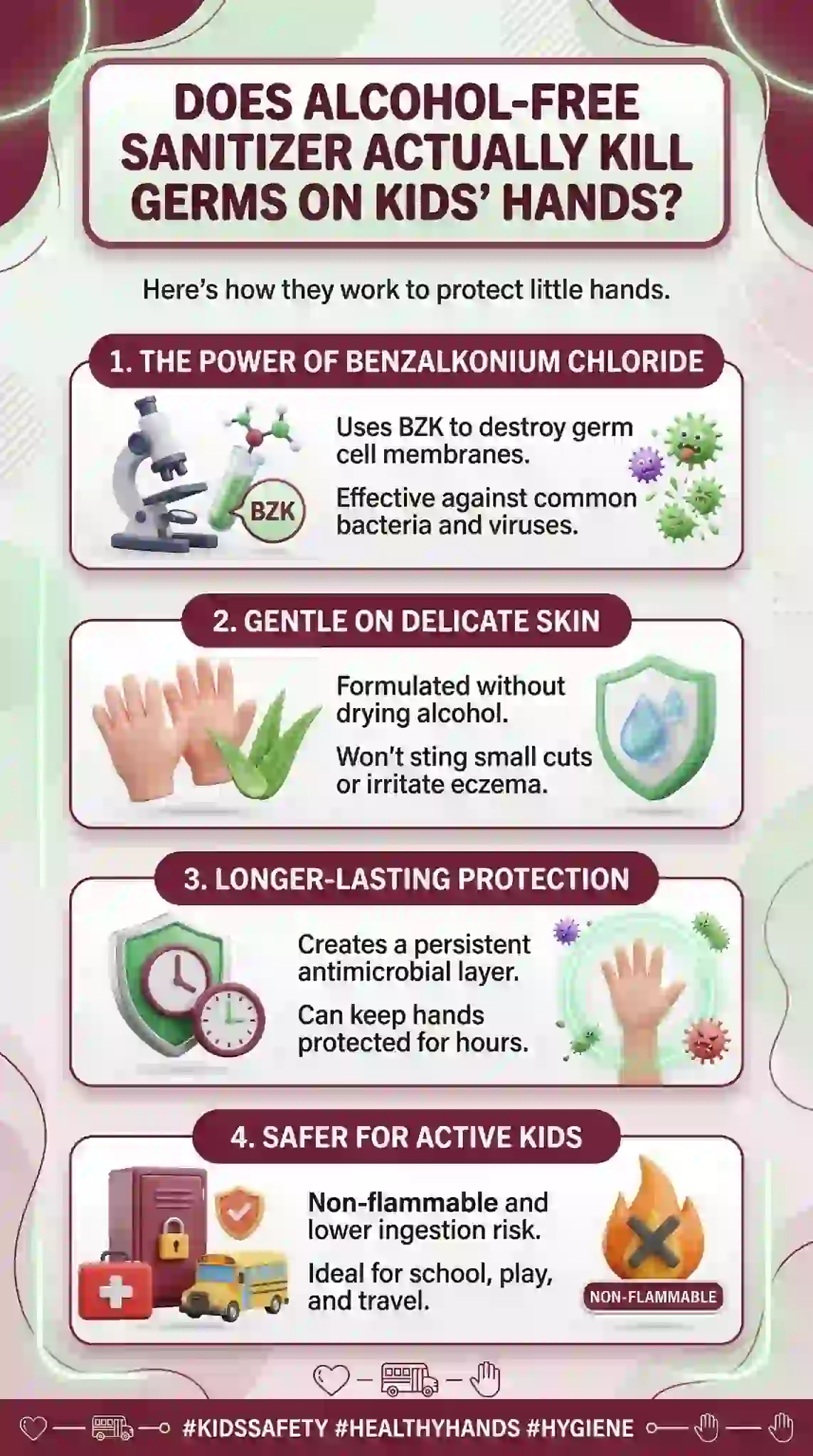
FAQ on Does Alcohol-Free Hand Sanitizer Actually Kill Germs on Kids' Hands?
Q: If alcohol-free hand sanitizer doesn't kill germs the same way alcohol does, how does it actually clean children's hands?
A: It starts by reframing what "clean" means. Killing and removing are different mechanisms.
The distinction:
Alcohol kills certain pathogens but leaves residue, dead cells, and chemical byproducts on skin
Physical removal lifts germs, dirt, and oil from the skin surface — nothing left behind
Removal covers pathogens alcohol cannot reach — including norovirus, the leading cause of school illness outbreaks
How NOWATA™ delivers this:
Plant-based clumping technology physically lifts and carries contaminants away from skin
No sink required
Independently tested by Microbe Investigations AG, Switzerland
Protocol: modified ASTM E1174
Result: 99.9% removal of germs, dirt, and oil
We did not choose removal because it was easier to formulate. We chose it because it was the only mechanism that science — and our clinical experience — could fully support for children.
Q: Does alcohol-free hand sanitizer protect children against norovirus — the stomach bug behind most school illness outbreaks?
A: Yes. This is the answer conventional sanitizers cannot give.
What the CDC confirms:
Alcohol-based sanitizers are ineffective against norovirus at any concentration
Norovirus is nonenveloped — alcohol cannot penetrate its protein shell
Physical removal is the CDC-recommended approach when alcohol fails
The pediatric burden annually:
19–21 million U.S. norovirus cases
24,000 hospitalizations in children under 18
132,000 emergency room visits
925,000 outpatient visits
We watched this cycle in our emergency department season after season. Families who used the sanitizer, followed the guidance, and still ended up in our waiting room. The product failed them before they walked through our doors. NOWATA™ is built around the removal mechanism that actually addresses the pathogen driving those visits.
Q: How do I know if an alcohol-free hand sanitizer has actually been tested — and is not just marketing?
A: This is the question we asked ourselves throughout two years of development.
Three things that separate clinical credibility from a label claim:
Independent laboratory testing — not internal, not anecdotal
A disclosed, recognized test protocol — look for ASTM E1174 or equivalent
A named third-party testing organization with verifiable credentials
How NOWATA™ meets that standard:
Tested by Microbe Investigations AG, Switzerland
Protocol: modified ASTM E1174 — the same standard applied to healthcare hand hygiene products
Result: documented laboratory outcome, not a percentage chosen for the front of a bottle
We refused to release a product we could not defend in a clinical conversation with a parent. Independent testing was not optional. It was the minimum standard before we considered the product ready.
Q: Is alcohol-free hand sanitizer safe for children to use repeatedly throughout the school day — including kids with eczema or reactive skin?
A: For children with eczema or reactive skin, this is not a precaution. It is the clinical reason alcohol-based sanitizers are the wrong product entirely.
What the research confirms:
Alcohol strips the skin's natural lipid barrier with every application
Children's skin barrier does not reach adult-level function until approximately age five
Repeated alcohol exposure elevates transepidermal water loss and triggers flares in reactive skin
What repeated daily use of NOWATA™ does not do:
Strip the lipid barrier
Trigger alcohol-related eczema flares
Leave synthetic fragrance or preservatives on the skin surface
Introduce any ingredient we could not defend in a clinical dermatology conversation
We treated sanitizer-triggered dermatitis in our own patients before we built this product. We were not willing to create another version of the problem we were already treating.
Q: If soap and water are available, is alcohol-free hand sanitizer still worth using — or is it just a backup option?
A: Soap and water is the gold standard. We say that as the founders of a waterless hand hygiene product — and we mean it without qualification.
Where NOWATA™ closes a gap neither soap nor alcohol sanitizer can fully address: portability.
The moments that require clean hands most urgently:
After touching a grocery cart, playground equipment, or a public door handle
Before eating at a park bench, sports field, or school lunch table without sink access
During a school day when shared surfaces are constant and sink access is limited
Any moment a child's hands need to be clean and a sink is not available
In those moments the choice is not NOWATA™ versus soap and water. It is NOWATA™ versus an alcohol sanitizer that:
Misses norovirus entirely
Compromises the skin barrier with every use
Leaves chemical residue behind on skin that absorbs it differently than adult skin does
That comparison is not close. We built NOWATA™ for exactly those moments — not to replace the sink, but to be the most clinically sound option when the sink is not available.