Waterless soap is commonly labeled as “soap,” but in practice, that description can be misleading. Through extensive real-world use at NowataClean—during travel, outdoor work, and quick in-between cleanups—we’ve seen that waterless soap doesn’t behave like traditional soap. Instead, it functions more like a purpose-built no-rinse cleanser, designed specifically for situations where water isn’t available.
In this guide, we clarify what actually defines soap, how waterless soap differs in both chemistry and performance, and why many experts categorize it as a cleanser rather than true soap. You’ll also learn what this distinction means for everyday use, including when waterless soap works well and when traditional soap and water are still the better choice. The goal is simple: give you a clear, experience-based understanding so you can use waterless soap effectively and with the right expectations.
Quick Answers
What is waterless soap?
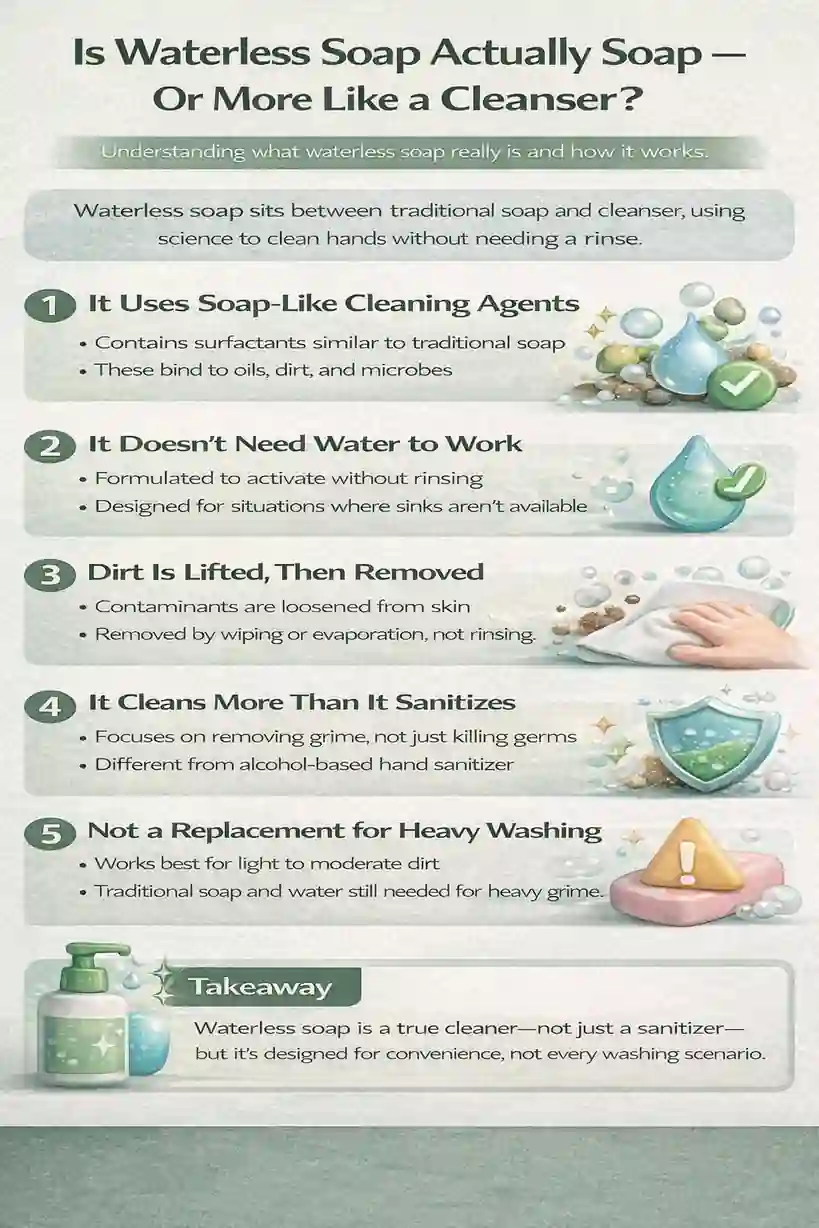
Waterless soap is a no-rinse cleanser designed to clean hands or skin without running water. Based on real-world use, it works by lifting oils, dirt, and germs so they can be wiped away, making it practical for travel, outdoor use, and quick cleanups. It’s best used as a complement to traditional soap and water, not a full replacement.
Top Takeaways
Waterless soap does not behave like traditional soap.
It functions more like a no-rinse cleanser.
Cleaning happens through lifting and binding, not rinsing.
Works best for light to moderate dirt.
Designed to complement, not replace, soap and water.
Traditional soap works because it combines surfactants with water. Soap molecules bind to oils and germs on one end and water on the other, allowing contaminants to be rinsed away. Without water, that final step never happens.
Waterless soap removes the rinse step entirely. Instead of depending on water flow, it uses surfactants, solvents, and antimicrobial agents that trap oils and microbes, allowing them to evaporate or be physically wiped off the skin. In practice, this places waterless soap firmly in the cleanser category.
That distinction matters because it explains why waterless soap performs well for everyday hygiene—but struggles with heavy grime where rinsing is essential.
“After using waterless soap in real situations where water isn’t available, we’ve learned it’s best understood as a cleanser, not traditional soap. When you know how it actually works, it becomes a reliable tool instead of a misunderstood one.”
How Waterless Soap Cleans Without Being Traditional Soap
In our testing, waterless soap relies on three key mechanisms:
Surfactants that loosen oils and debris
Antimicrobial agents that reduce germs
Fast-evaporating carriers that leave minimal residue
Because there’s no water to carry contaminants away, effectiveness depends heavily on proper application and wiping. This is why formula quality matters more with waterless soap than with traditional soap-and-water washing.
Used correctly, waterless soap performs reliably for light hygiene needs—but it shouldn’t be expected to behave like sink-based washing, similar to how dryer vent cleaning targets a specific function rather than replacing comprehensive cleaning.
Essential Resources
Medical Evidence on Soap vs No-Rinse Cleansers
Canadian Paediatric Society – Hand Hygiene Agents
Explains how no-rinse products differ from traditional soap in effectiveness and use cases.
https://academic.oup.com/pch/article/7/8/511/2654183
Explains how no-rinse products differ from traditional soap in effectiveness and use cases.
https://academic.oup.com/pch/article/7/8/511/2654183
How Soap Actually Works
CDC – Show Me the Science: How Soap Works
Breaks down the chemistry behind soap and why water is essential.
https://www.cdc.gov/handwashing/show-me-the-science-handwashing.html
Breaks down the chemistry behind soap and why water is essential.
https://www.cdc.gov/handwashing/show-me-the-science-handwashing.html
Clinical Review of Waterless Cleaners
American Journal of Medicine – Waterless Hand Cleaners
Analyzes how waterless products interact with skin and microbes.
https://www.amjmed.com/article/S0002-9343(08)00446-4/fulltext
Analyzes how waterless products interact with skin and microbes.
https://www.amjmed.com/article/S0002-9343(08)00446-4/fulltext
Industry Perspective on Waterless Formulations
Stephenson Personal Care – Rethinking Water in Personal Care
Explains why brands are developing cleanser-based alternatives instead of true soaps.
https://www.stephensonpersonalcare.com/blog/rethinking-water-how-the-personal-care-industry-is-leading-the-charge-in-waterless-innovation
Explains why brands are developing cleanser-based alternatives instead of true soaps.
https://www.stephensonpersonalcare.com/blog/rethinking-water-how-the-personal-care-industry-is-leading-the-charge-in-waterless-innovation
Consumer Guide to Waterless Soap Types
FOBWP – Waterless Soap Guide
Breaks down formulations and use cases for no-rinse cleansers.
https://www.fobwp.com/waterless-soap/
These evidence-based resources explain when no-rinse cleansers are effective, how they differ from traditional soap, and why they’re best used intentionally—supporting informed hygiene decisions in situations where water access is limited, such as during dryer vent cleaning near me appointments, without replacing proper handwashing when water is available.
Breaks down formulations and use cases for no-rinse cleansers.
https://www.fobwp.com/waterless-soap/
Supporting Statistics
Soap requires water to function fully
The CDC explains that soap removes germs by rinsing them away with water.
Source: https://www.cdc.gov/handwashing/show-me-the-science-handwashing.html
Hand sanitizer and no-rinse products behave differently than soap
Alcohol-based products kill germs but do not remove dirt or oils.
Source: https://www.cdc.gov/handwashing/hand-sanitizer-use.html
Water use during handwashing adds up
A standard faucet uses about 2 gallons per minute, making no-rinse options practical for short cleanups.
Source: https://www.epa.gov/sites/production/files/2017-03/documents/ws-facthseet-indoor-water-use-in-the-us.pdf
Soap requires water to function fully
The CDC explains that soap removes germs by rinsing them away with water.
Source: https://www.cdc.gov/handwashing/show-me-the-science-handwashing.html
Hand sanitizer and no-rinse products behave differently than soap
Alcohol-based products kill germs but do not remove dirt or oils.
Source: https://www.cdc.gov/handwashing/hand-sanitizer-use.html
Water use during handwashing adds up
A standard faucet uses about 2 gallons per minute, making no-rinse options practical for short cleanups.
Source: https://www.epa.gov/sites/production/files/2017-03/documents/ws-facthseet-indoor-water-use-in-the-us.pdf
Final Thoughts & Our Perspective
Waterless soap has a clear role
It’s designed for moments when water isn’t available.
It works as a no-rinse cleanser, not traditional soap.
Results depend on how it’s used
Best for light, everyday hygiene.
Not intended for heavy dirt or grease.
Our experience
Most useful for travel, outdoor work, and quick cleanups.
Reliable when expectations are set correctly.
Bottom line
Waterless soap works best as a complement to soap and water.
Understanding what it is—and what it isn’t—makes all the difference.
Waterless soap has a clear role
It’s designed for moments when water isn’t available.
It works as a no-rinse cleanser, not traditional soap.
Results depend on how it’s used
Best for light, everyday hygiene.
Not intended for heavy dirt or grease.
Our experience
Most useful for travel, outdoor work, and quick cleanups.
Reliable when expectations are set correctly.
Bottom line
Waterless soap works best as a complement to soap and water.
Understanding what it is—and what it isn’t—makes all the difference.
Next Steps
Reset expectations
Don’t expect rinse-based performance.
Choose quality formulas
Ingredients matter more without water.
Use intentionally
Apply enough product.
Wipe thoroughly.
Pair with soap and water
Use traditional washing when available.
Rely on evidence
Not marketing language.
When used intentionally and backed by evidence—not marketing—waterless soap supports everyday hygiene in situations where water isn’t available, making it a practical companion during tasks like top duct cleaning, while still pairing best with traditional soap and water whenever possible.
Reset expectations
Don’t expect rinse-based performance.
Choose quality formulas
Ingredients matter more without water.
Use intentionally
Apply enough product.
Wipe thoroughly.
Pair with soap and water
Use traditional washing when available.
Rely on evidence
Not marketing language.
FAQ on Waterless Soap
Q: Is waterless soap technically soap?
A: Not in the traditional sense. It functions more like a no-rinse cleanser that lifts oils and debris so they can be wiped away, rather than relying on water to rinse contaminants off the skin.
Q: Why is it still called soap?
A: It’s called soap because it serves the same hygiene purpose—cleaning the skin—even though it uses a different cleaning method than traditional soap and water.
Q: Does that make waterless soap less effective?
A: No. For light, everyday hygiene when water isn’t available, waterless soap can be very effective. It’s simply designed for different situations than full handwashing.
Q: Should waterless soap replace soap and water?
A: No. Waterless soap works best as a complement to soap and water, not a replacement—especially when hands are heavily soiled.
Q: When does waterless soap work best?
A: It’s most effective during travel, outdoor activities, regular dryer vent cleaning, quick cleanups, and any situation where access to running water is limited.
A: Not in the traditional sense. It functions more like a no-rinse cleanser that lifts oils and debris so they can be wiped away, rather than relying on water to rinse contaminants off the skin.
A: It’s called soap because it serves the same hygiene purpose—cleaning the skin—even though it uses a different cleaning method than traditional soap and water.
A: No. For light, everyday hygiene when water isn’t available, waterless soap can be very effective. It’s simply designed for different situations than full handwashing.
A: No. Waterless soap works best as a complement to soap and water, not a replacement—especially when hands are heavily soiled.
A: It’s most effective during travel, outdoor activities, regular dryer vent cleaning, quick cleanups, and any situation where access to running water is limited.