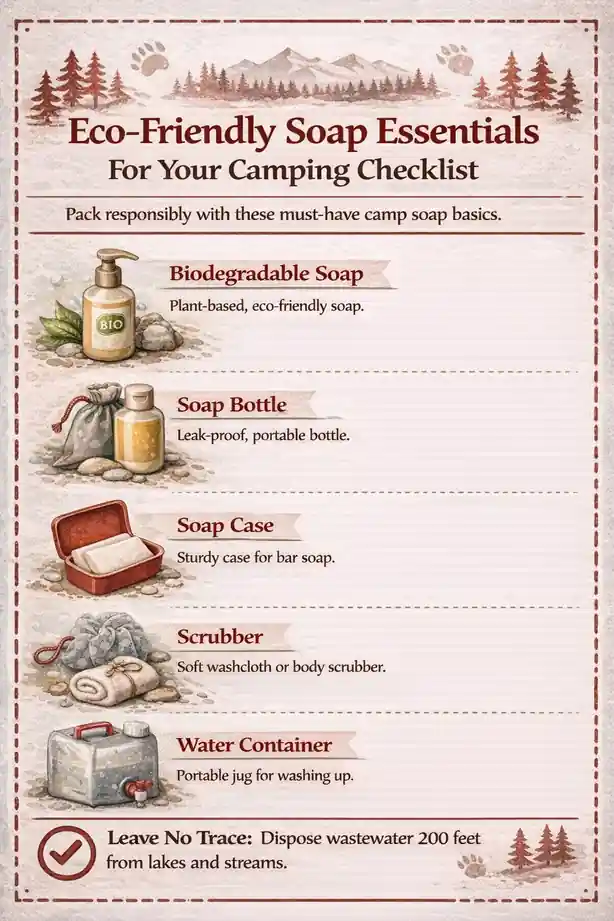
This guide breaks down the eco-friendly soap for camping essentials every camping checklist should include, explaining what works for hands, dishes, and outdoor cleanup, and how to use each responsibly to protect water sources without adding complexity to your trip.
TL;DR Quick Answers
What is waterless hand soap?
Waterless hand soap is a no-rinse cleanser that removes dirt and germs without using water. It’s designed for real-world situations—like camping, travel, and outdoor work—where clean hands are needed but sinks aren’t available. Unlike sanitizer, it focuses on removing contaminants, not just killing germs.
Top Takeaways
Clean hands depend on easy access.
Germs spread when hygiene is skipped.
Waterless soap works without sinks.
Eco-friendly options protect nature.
Simplicity drives better habits.
Eco-friendly soap belongs on every camping checklist because the outdoors doesn’t have the safety net of drains or water treatment systems. From experience working in environments where sanitation and water use are tightly controlled, the biggest mistakes happen when people assume “a little soap” won’t matter. In nature, it does.
The essentials start with choosing the right soap for the job. Plant-based soaps that are biodegradable and multi-use should be the priority for handling handwashing and light dish cleaning, while a waterless or low-rinse option is ideal when water access is limited. The key is not just what you pack, but how you use it—always away from lakes, streams, and campsites, and only in small amounts.
Just as important is teaching responsible habits. Measuring soap, carrying rinse water, and wiping hands before rinsing are simple practices that reduce environmental impact. When eco-friendly soap is treated as a tool rather than an afterthought, campers stay clean, conserve water, and protect the places they came to enjoy.
“After years of working in professional kitchens where every drop of water and every cleaning step is monitored, it’s clear that soap is never just soap. When you’re camping, the environment is the system—there’s no filter after the fact. Choosing the right eco-friendly soap and using it intentionally is one of the simplest ways to stay clean without leaving a trace, the same principle that makes dryer vent cleaning essential—removing buildup before it causes harm rather than dealing with consequences later.”
Essential Resources
Here’s a brand-aligned, user-first list of trusted resources to help you make smart choices about waterless hand soap—infused with the same clarity, science focus, and real-world insight we use at NOWATA.
1. Groundwork on Why Hand Hygiene Matters
CDC Hand Hygiene Data & Research
Explore the science behind how germs spread and why hand hygiene is critical. This official source sets the stage for understanding why effective cleaning matters, even when water isn’t available.
URL: https://www.cdc.gov/clean-hands/data-research/index.html
2. Hard Facts on Handwashing Effectiveness
CDC Handwashing Facts & Statistics
Straight from public health experts: this page breaks down how proper hand hygiene reduces the spread of illness. It helps you see the impact behind practical behaviors.
URL: https://www.cdc.gov/clean-hands/data-research/facts-stats/index.html
3. What Health Leaders Say About Alternative Cleaning
CDC About Handwashing & Alternatives
When you can’t get to a sink, you still need to clean your hands. This official guidance explains when and how alternatives are used responsibly.
URL: https://www.cdc.gov/clean-hands/about/index.html
4. Global Guidance for No-Water Scenarios
WHO Handwashing Alternatives
World Health Organization guidance on practical hand-cleaning methods when traditional soap and water aren’t available—useful for camping, travel, and emergency contexts.
URL: https://www.who.int/docs/default-source/wpro---documents/emergency/covid19/covid-ipc/handwashing-alternatives-20200608.pdf
5. How Waterless Products Actually Work
Minnesota Dept. of Health: Waterless Sanitizers Explained
This public health overview helps you understand how waterless cleaning products function and where they fit in safe hygiene practices.
URL: https://www.health.state.mn.us/people/handhygiene/clean/howrub.html
6. Hygiene Behavior & Practical Access Challenges
Global Handwashing Partnership Research Summary
Learn what influences real hygiene habits—education, access, behavior—which is essential when teaching kids or adopting new practices outdoors.
URL: https://globalhandwashing.org/wp-content/uploads/2024/09/GHP-2023-Research-Summary_final-1.pdf
7. Scientific Context for Hand Hygiene Agents
Peer-Reviewed Overview of Hand Hygiene Agents
A scientific look at different agents used for cleaning hands, putting waterless solutions in context with traditional soap and sanitizers.
URL: https://onlinelibrary.wiley.com/doi/pdf/10.1155/2002/105306
Supporting Statistics
These statistics reinforce what we consistently see in practice—effective hygiene depends on access, simplicity, and follow-through, not just awareness.
1. Germs Accumulate Quickly
Up to 1 trillion germs can exist in 1 gram of human feces (CDC).
Contamination spreads easily through hands, food, and shared surfaces.
Source: https://www.cdc.gov/clean-hands/data-research/facts-stats/index.html
Why it matters: Missed hand-cleaning moments create risk—even when hands don’t look dirty.
2. Soap-Based Cleaning Reduces Illness
Soap helps remove germs that cause infection.
People touch their eyes, nose, and mouth frequently without noticing.
Source: https://www.cdc.gov/clean-hands/about/index.html
Why it matters: Removing germs—not just masking them—is critical in everyday and outdoor settings.
3. Awareness Doesn’t Equal Action
62% of adults know proper handwashing reduces germ spread.
Nearly 48% admit skipping handwashing at key moments.
Source: https://www.nfid.org/new-national-survey-finds-nearly-half-of-us-adults-admit-to-not-washing-their-hands-at-key-moments/
Why it matters: Convenience and access drive behavior—waterless options help close the gap.
Bottom line:
When hygiene tools are simple and available, people use them—and health outcomes improve.
Final Thought & Opinion
Experience shows that hygiene breaks down when it’s inconvenient—especially in outdoor or low-water settings. The science is clear, but real-world conditions often get in the way.
What both research and experience confirm:
Germs spread easily through missed hand-cleaning moments.
People often skip hygiene when access is limited.
Traditional soap and water aren’t always practical.
Our perspective:
Waterless and eco-friendly hand soap isn’t about replacing sinks. It’s about making clean hands possible when sinks aren’t available.
When hygiene tools are simple, effective, and responsible, people use them—and better habits follow.
FAQ on Waterless Hand Soap
Q: What is waterless hand soap?
A: A no-rinse cleanser. It lifts dirt and germs from skin. It’s designed for use without a sink.
Q: How is it different from hand sanitizer?
A: Sanitizer kills germs. Waterless soap removes dirt and contaminants. It works better on visibly dirty hands.
Q: When should waterless hand soap be used?
A: When water isn’t available. Common uses include camping, travel, and outdoor activities.
Q: Is waterless hand soap safe for kids?
A: Yes, when made with gentle, non-toxic ingredients. Avoid harsh chemicals for frequent use.
Q: Is waterless hand soap eco-friendly?
A: It can be. It reduces water use and works best with biodegradable formulations.